The eLeaP Intelligence Hub
Better decisions for quality, training, and performance.

-
AS9100 Supplier Quality and Counterfeit Part Prevention: Controlling Risk Across a Multi-Tier Aerospace Supply Chain


Picture a receiving inspector at a Tier 2 aerospace machine shop. A lot of corrosion-resistant fasteners arrives from a distributor the buyer approved two years earlier. The certificate of conformance looks complete, the packaging looks right, and the shipment landed on time after three late deliveries. Under schedule pressure, the lot moves to stock. Six […]
-
Risk-Based Internal Audit Programs for Regulated Manufacturers: One Framework Across ISO 13485, AS9100, IATF 16949, ISO 22000, and GMP
Picture a quality director who oversees three plants in one manufacturing group. One plant molds housings for infusion pumps under ISO 13485. A second stamps brackets for an automotive Tier 1 supplier under IATF 16949. The third machines flight-critical fittings under AS9100. Each plant runs its own internal audit schedule, built years ago from a […]
-
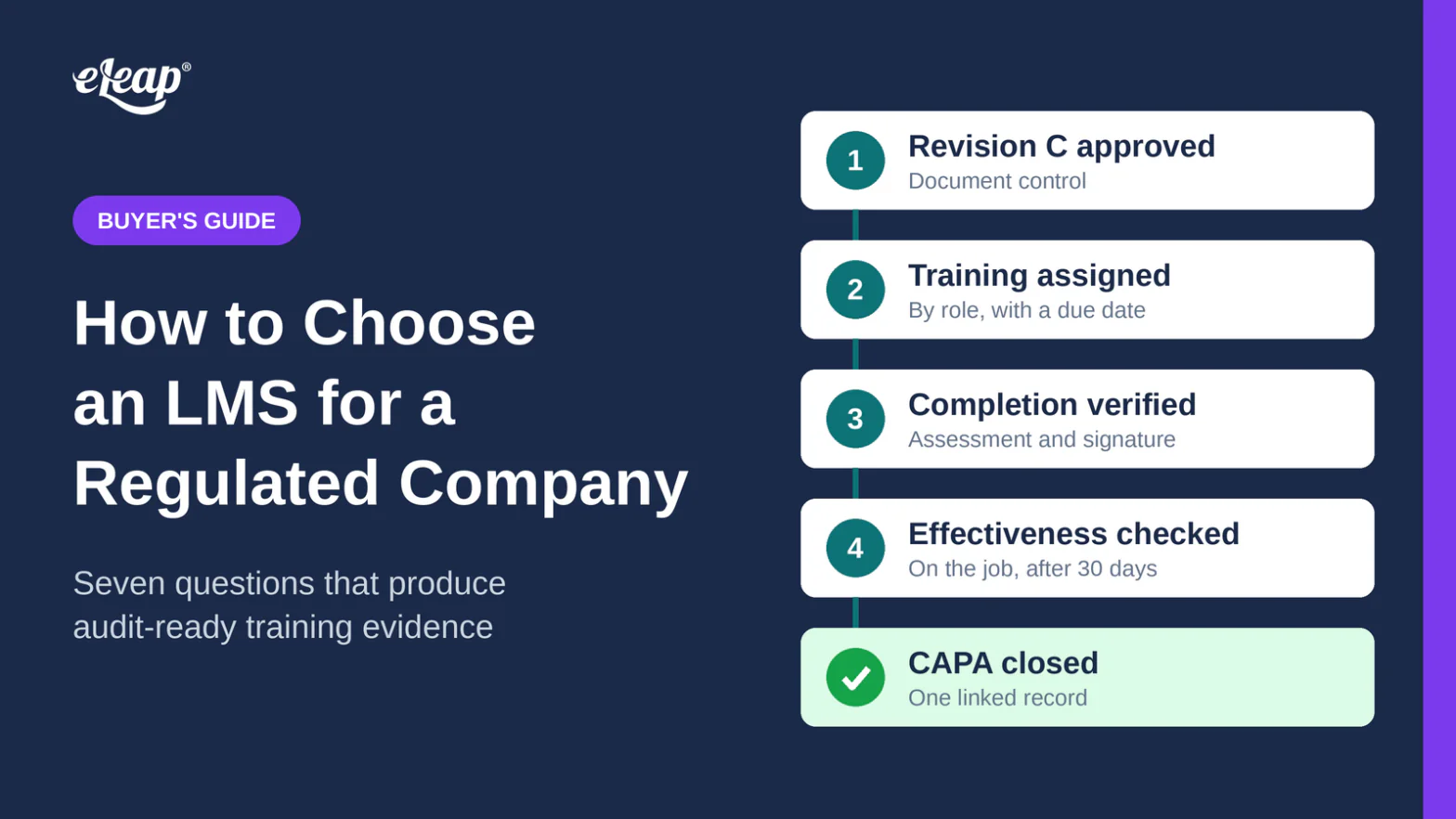
How to Choose an LMS for a Regulated Company: Seven Questions That Produce Audit-Ready Evidence

A regulated company does not pick a learning management system (LMS) on course features. It picks one on whether the system can prove, in a single record, that the right person completed the right version of the right material at the right time. This article gives you the definition, the controls to check, a worked […]
-
Informal Learning: How to Improve Workplace Learning With an LMS
Think about the last time you learned something useful at work, and chances are it did not happen in a course. A colleague showed you a shortcut, or you fixed a problem and remembered the fix for next time. That is informal learning, and it fills a large part of every working week even though […]
-
Formal Learning: How to Build Effective Training Programs
Most organizations run plenty of courses, yet few can show that those courses change how people work on the job. Formal learning closes part of that gap because it adds structure to employee training, including clear objectives, planned instruction, and defined assessment. A Learning Management System (LMS) then handles course delivery, assignments, and progress tracking […]
-
Quality Training Software: How to Choose the Right LMS
Assigning a course and tracking a completion rate sounds simple. Quality training is harder. Auditors want to know who trained on which procedure, under which version, and whether the training worked. A learning management system (LMS) can solve much of that problem. Used well, it manages role-based training, employee competency, SOP training, recurring training, and […]
-
Quality System Training: Build an Audit-Ready LMS Program
Most quality teams can print a training completion report. Far fewer can prove that an operator performs a critical task correctly. That gap triggers audit findings. Quality system training closes it. The right program links every role to the procedures, skills, and evidence your quality management system demands. This guide explains what quality system training […]
-
eLearning Personalization for Better LMS Training
Picture a new sales hire and a ten-year veteran sitting through the same compliance course. One learns nothing new, while the other drowns in unfamiliar terms. That is the real cost of identical course assignments: training hours pile up, completion rates look fine, and skills barely move. eLearning personalization fixes this problem inside your LMS. […]
-
Course Catalog: How to Organize LMS Training
Your training library probably started small, with a few onboarding videos, one safety course, and a folder of policies. Then departments added their own content, compliance modules piled up, and the list outgrew its structure. A bigger library does not create a better learning experience on its own, because employees who cannot find relevant training […]
-
FMEA and Risk-Based Maintenance: Why Equipment Failure Is a Quality Problem Before It’s a Maintenance Problem
A stamping press starts producing parts with a dimensional drift too small to trip an in-process alarm but large enough to accumulate into a nonconformance three shifts later. The maintenance log shows nothing unusual – the press is running, it isn’t down, and no one has scheduled an intervention for equipment that hasn’t failed yet. […]
-
Post-Market Surveillance Under QMSR: Why Complaint Handling Is Now a Design Control Problem
A device manufacturer receives a complaint about a connector that separates under normal use. The complaint gets logged, triaged as isolated, and closed with a note that the device performed within specification during the original design verification testing. Four months later, a second complaint arrives describing the identical failure mode, then a third. By the […]
-
CDMO and CRO Quality Agreements: Outsourced Oversight When the Client Owns the Product, Not the Process
A sponsor company signs a manufacturing agreement with a CDMO, ships over a validated process and a specification package, and moves on to the next milestone on the regulatory timeline. Eighteen months later, an FDA investigator asks the sponsor’s quality director a direct question: who approved this deviation, and why does your quality system show […]







Search articles by...
Find your way around our blog by searching using a keyword or a group of keywords or by choosing a tag.