Regulated Training Record Compliance: QMS & LMS Guide
Show who was trained on which version, by whom, and that they could do the work.
Regulated training record compliance is the ability to demonstrate, through trustworthy records, that personnel possess the education, training, skills, experience and qualifications appropriate to their assigned regulated activities. Where work is governed by a controlled procedure, the evidence should establish that applicable revision-specific training and qualification requirements were satisfied before independent work was performed. It answers a question that follows from the other compliance controls: who was trained on which version, by whom, and could they actually do the work? This guide covers what the rules expect, what a training record should contain, how to build a training matrix, effectiveness checks, signatures, retraining triggers and what to test. It focuses on FDA-regulated QMS and LMS environments, so other frameworks may add requirements. Retraining on every procedure revision is a common organizational policy, not a universal regulatory requirement, so the guide separates what the rules say from what a mature procedure adds.
What does regulated training record compliance require?
No single rule describes the record. Several rules require training and qualification, and the record is how you prove you met them. Which apply depends on your product and region.
| Source | What it expects | Applies to |
|---|---|---|
| 21 CFR 11.10(i) | Confirm that people who develop, maintain or use electronic record and signature systems have the education, training and experience for their tasks | Electronic records within Part 11 scope |
| 21 CFR 11.10(j) | Written policies that hold individuals accountable for actions taken under their electronic signatures, and compliance with those policies | Electronic signatures within Part 11 scope |
| 21 CFR 211.25(a) | Personnel have the education, training and experience for their tasks, including CGMP training for their role, given by qualified individuals often enough to stay current. The section does not itself list record content | Drug manufacturing under CGMP |
| 21 CFR 211.25(b) | People who supervise manufacturing have the education, training and experience to perform their assigned functions so that the drug has the quality it purports to have | Drug manufacturing under CGMP |
| ISO 13485:2016 clause 6.2 | Personnel whose work affects product quality are competent. Determine competence, provide training or other actions, evaluate their effectiveness, ensure awareness and keep records of education, training, skills and experience | Medical device quality management systems, incorporated by the QMSR |
| ISO 13485:2016 clause 4.2.5 | Records are controlled, kept legible and retrievable, and retained for at least the defined medical device lifetime or as specified by applicable regulatory requirements, but not less than two years from device release | Medical device quality management systems |
| EU GMP Chapter 2, clause 2.11 | Initial and continuing training, with practical effectiveness periodically assessed, programmes approved by production or quality control heads, and training records kept | GMP manufacturers in the EU |
| EU GMP Annex 11, clause 2 | Personnel involved with computerised systems have appropriate qualifications, access levels and defined responsibilities | GMP computerised systems in the EU |
| EU GMP Annex 11, clause 12 | Access is restricted to authorised people, and the creation, change and cancellation of access authorisations are recorded | GMP computerised systems in the EU |
For devices, FDA’s QMSR incorporates ISO 13485:2016, so clause 6.2 is where personnel competence requirements now come from. Read the sources directly: 21 CFR 11.10, 21 CFR 211.25 and EU GMP Chapter 2. Confirm with your regulatory team how they apply to you, and see our 21 CFR Part 11 guide.
What evidence does regulated training record compliance need?
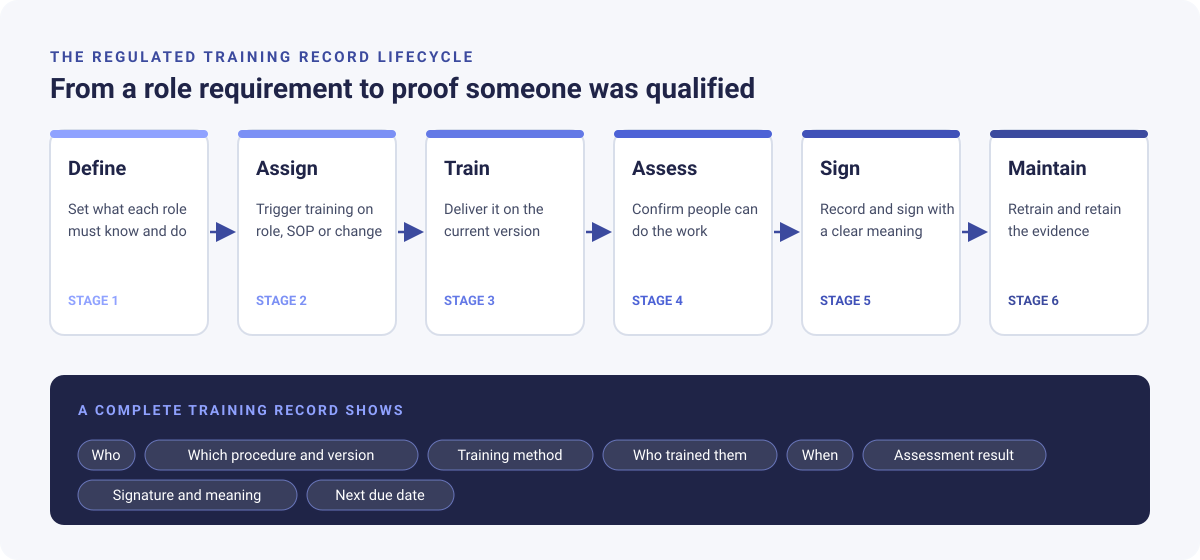
A completion record is only the start. Think of six separate questions, each with its own evidence. Which you need depends on the risk of the task.
| Stage | Question | Example evidence |
|---|---|---|
| 1. Assigned | Was the person required to train, and on which revision? | Training matrix and assignment record |
| 2. Completed | Did they finish the training that was delivered? | Completion with date, time and version |
| 3. Effectiveness evaluated | Was the training checked for effectiveness? | Assessment result or observation |
| 4. Competence demonstrated | Could they perform the task? | Observed performance or trainer sign-off |
| 5. Qualification established | Did an authorized person decide they were qualified? | Qualification record with signature and meaning |
| 6. Work authorized | Who was permitted to perform the task, and under which rule? | Authorization per your procedure, linked to the work record |
A completion record covers only stages 1 and 2. Stages 3 to 6 depend on your risk assessment and your procedures.
Is a completed course enough to show regulated training record compliance?
Usually not. ISO 13485 asks you to evaluate the effectiveness of the actions you took, and EU GMP asks for practical effectiveness to be periodically assessed. A completion record shows delivery. It does not show that the person can do the work. Choose the check by the risk of the task.
| Training type | Evidence of delivery | Example effectiveness check |
|---|---|---|
| Read and acknowledge a procedure | Acknowledgment with the document version | Short knowledge check on the key steps |
| Instructor-led session | Attendance, trainer and date | Quiz or observed demonstration |
| On-the-job training | Trainer sign-off on tasks performed | Supervised performance and a qualification decision |
| E-learning with assessment | Completion and score | Passing score, with retraining on failure |
| Equipment or method qualification | Per-person authorization record | Practical assessment before independent work |
How should effectiveness checks vary by risk?
Match the strength of the check to the consequence of an error. These tiers are illustrative.
| Task risk | Example task | Suggested check | Note |
|---|---|---|---|
| Lower | General awareness or policy training | Read and acknowledge, with a short quiz | Proves delivery and basic understanding |
| Medium | GMP procedure that affects product or records | Assessment with defined passing criteria | Retraining and reassessment on failure |
| Higher | Critical process step, aseptic work or release decision | Observed performance with trainer sign-off and a qualification decision | Independent work only after qualification, as your procedure defines |
Be careful with aggregate scores. A person can reach 95 percent and still miss the one step that matters. For higher-risk tasks, define critical questions or steps that must be correct regardless of the overall score.
What should a training record contain?
A complete record for regulated training record compliance answers who, what, which version, how, when and with what result. This layout is illustrative. Define the content for your own procedures.
| Field | Illustrative entry |
|---|---|
| Person | Unique user ID and name |
| Role and department | Production operator, packaging |
| Requirement | SOP-0042, revision 03 (the version in effect) |
| Training method | Instructor-led session with knowledge check |
| Trainer | Qualified trainer, named |
| Date and time completed | System time stamp |
| Assessment result | Passed, score recorded |
| Signature and meaning | Trainee signature, meaning: Training completed |
| Next due | Retraining date or trigger |
| Status | Complete |
Illustrative record, not an eLeaP export.
What does a qualification record look like for regulated training record compliance?
A qualification record goes beyond completion. This sequence uses roles and sample dates and is illustrative only.
| Step | Illustrative entry |
|---|---|
| Person and role | Packaging operator A |
| Requirement | SOP-0042, revision 03, effective 2026-03-01 |
| Training assigned | 2026-02-20 |
| Training completed | 2026-02-26, with passing knowledge check |
| Observed performance | 2026-02-27, by a qualified trainer, steps performed as written |
| Qualification decision | 2026-02-28, by the supervisor, with signature and meaning |
| Authorized for the task | From 2026-03-01, per the procedure |
Illustrative sequence, not an eLeaP export.
How do you build a training matrix?
A training matrix specifies who must be trained on what, so that gaps in regulated training record compliance show up before an inspector finds them. Keep it inside the system that assigns training, not in a parallel spreadsheet that can drift.
| Role | Required training | Trigger | Assessment | Frequency |
|---|---|---|---|---|
| QA specialist | GMP fundamentals | Role assignment | Knowledge assessment | Periodic refresher |
| Production operator | Manufacturing SOP | SOP revision in effect | Knowledge check | When required by the training impact assessment |
| QC analyst | Laboratory procedure | New procedure | Practical assessment | When required by the training impact assessment |
| Equipment operator | Equipment qualification | New equipment or method | Observed performance | Per your procedure |
Build it in layers: the role, the department or area, the specific equipment or task, and any special function. People with more than one function should carry the combined requirements of all of them. For how eLeaP links document control to training delivery, see SOP training software and GxP compliance training.
What does an individual training status matrix show?
Where the matrix says who should be trained, a status view says where each person stands today.
| Person | Requirement | Revision | Status | Next action |
|---|---|---|---|---|
| Operator A | SOP-0042 | Revision 03 | Qualified | Refresher on schedule |
| Operator B | SOP-0042 | Revision 02 completed | Overdue for revision 03 | Train before independent work |
| Operator C | SOP-0042 | Revision 03 | Assigned | Complete by the due date |
| Analyst D | SOP-0107 | Revision 05 | Failed assessment | Retrain and reassess |
A current status view is a snapshot. It does not prove who was qualified on a past date. For that you need version-specific records and the history behind them, as described below.
When must training be triggered or repeated?
Training is not a one-time event. Each change in the work should trigger a decision about training. Under 21 CFR 211.25 CGMP training must be given often enough to keep employees current, so set the frequency in your procedure.
| Trigger | Response |
|---|---|
| New hire or role change | Assign the training for the new role, and confirm completion before independent work |
| Procedure revision becomes effective | Assess training impact and assign applicable revision-specific training. See document version control |
| CAPA or deviation outcome | Retrain affected people when the corrective action changes how work is done |
| Change control | Complete applicable training and qualification before affected independent work |
| New equipment or method | Qualify each operator before independent use |
| Periodic refresher | Repeat at the interval your procedure sets, and assess effectiveness |
| Training failure | Remediate and reassess, with appropriate restrictions on affected work |
Does training have to be finished before a procedure takes effect?
The rules do not set one answer, so define it in your procedure and follow it. Common approaches are to complete training before the effective date, or to set a documented window in which only trained people perform the affected work. Whatever you choose, an inspector should be able to see who was trained on which revision before they performed the task.
What is a training workflow for an SOP revision?
A written workflow turns a revision into trained, qualified people. This eight-step sequence is illustrative.
| Step | Action | Evidence |
|---|---|---|
| 1 | Draft the revision and assess training impact | Impact assessment recorded with the change |
| 2 | Approve the revision and set the effective date | Approval signature and effective date |
| 3 | Set the assignment rule for affected roles | Matrix entry for the revision |
| 4 | Assign training for that revision | Assignment record with due date |
| 5 | Deliver the training | Completion record with revision |
| 6 | Assess effectiveness by risk | Assessment or observation result |
| 7 | Record the qualification decision | Signed decision, where required |
| 8 | Confirm status before work is assigned | Status check against the matrix |
Not every change needs the same response. Define the rule in your procedure.
| Type of change | Typical response |
|---|---|
| Editorial correction | Notify, or no training |
| Clarification without a change in steps | Read and acknowledge |
| Change to a step or parameter | Retrain with an assessment |
| New critical step, equipment or method | Observed performance and a qualification decision |
Which controls protect training records?
When electronic training records are kept to satisfy applicable regulatory recordkeeping requirements, determine which electronic record controls apply. Training records within the scope of 21 CFR Part 11 need appropriate protections for attribution, access, integrity, validation, retention and electronic signatures where applicable. FDA’s Part 11 scope and application guidance provides the framework for deciding scope.
| Control | What it protects | Related guide |
|---|---|---|
| Unique user identification and access limits | Attribution to one person, and authorized access only | 21 CFR Part 11 guide |
| Electronic signatures with meaning | Who confirmed completion and what the signature meant | Electronic signature compliance controls |
| Audit trail | Who created or changed a record, and when | Audit trail compliance controls |
| Version linkage | The training matches the procedure revision | Document version control |
| Validated system | The system performs as intended | Computerized system validation |
| Retention and retrieval | Records stay available and complete | Electronic record integrity and retention |
Agree the scope with your regulatory team, and consider applying the same controls to other training records as good practice. Part 11 also expects written policies that make people accountable for actions under their signatures. A trainee who signs a completion record should know the signature carries that accountability.
How do you test regulated training record compliance controls?
Test in your configured system and keep the evidence. These illustrative scenarios pair an action with the expected result.
| Scenario | Expected result |
|---|---|
| Approve or send an SOP revision using the configured workflow | Training is assigned to the intended roles for that revision |
| Complete training with a failing assessment | Completion is not recorded as qualified, and retraining is required |
| Complete training that requires a signature | Signature, meaning and time are recorded |
| Attempt to sign as another user | The signature is rejected |
| Change a user’s role | Training requirements update for the new role |
| Modify a completed training record | The change is attributed and the previous information is kept |
| Report training status for a date range | The report shows who was required, who completed and who is overdue |
| Retrieve an older training record | The record, its version link and its history are available |
| Retake an assessment after a failure | Both attempts are kept and the result is attributed |
| Revise an SOP again before training is finished | Open assignments follow your rule for the superseded revision |
| Assign training for an obsolete revision | The system or procedure prevents or flags it, as configured |
| Run a point-in-time compliance report for a past date | The report reflects who was required and who was trained on that date |
| Export a full training history for one person | All records, versions and results appear in the export |
| Reach a due date without completion | The item shows as overdue and escalates as configured |
| Change a trainer or approver role | Permissions change and the change is recorded |
| Trigger retraining from a CAPA outcome | The assignment links to the CAPA, per your configuration |
What does reconstructing who was qualified on a date look like?
Inspectors often start with a question about an event and work back to the person.
| Question an inspector might ask | Evidence you should be able to produce |
|---|---|
| Who performed this task on this date? | Batch or work record with the user ID |
| Which revision of the procedure was in effect? | Version history and effective dates |
| Were they trained on that revision before the task? | Training record with the revision and completion time |
| How do you know they could do the work? | Assessment result or qualification record |
| Who confirmed the training? | Signature with name, date, time and meaning |
| Has the record changed since? | Audit trail with actor, action and time |
How do you prove historical training and qualification compliance?
Sequence matters more than any single date. Compare two illustrative timelines for a revision effective 2026-03-01.
| Event | Sequence that supports compliance | Sequence that raises a question |
|---|---|---|
| Revision effective | 2026-03-01 | 2026-03-01 |
| Training completed | 2026-02-26 | 2026-03-09 |
| Qualification decision | 2026-02-28 | Not recorded |
| Task performed | 2026-03-04 | 2026-03-04 |
| Reading | Trained and qualified before the task | Task performed before training, which needs a documented assessment under your procedure |
Who is responsible for regulated training record compliance?
You are. A vendor supplies the platform, but the regulated organization defines competence, sets the matrix, approves the training and decides what counts as qualified.
| Activity | Vendor | Your organization |
|---|---|---|
| Platform controls for access, signatures and audit trail | Provides | Configures and tests |
| Training matrix content | Supports | Owns |
| Training material and assessments | Supports | Owns |
| Trainer qualification | Supports | Owns |
| Effectiveness checks and qualification decisions | Supports | Owns |
| Retention schedule for training records | Supports | Owns |
What are the most common regulated training record compliance failures?
| Failure | Control that prevents it |
|---|---|
| Completion recorded without an effectiveness check | Assessments or observed performance chosen by risk |
| Training not tied to the procedure revision | Version-specific assignments and records |
| Work done before training was completed | A rule on timing and a status check before assignment of work |
| Training matrix kept in a spreadsheet that drifts | A matrix managed in the system that assigns training |
| Shared accounts or signed on behalf of others | Unique IDs and signature controls |
| Retraining not triggered by CAPA or change | Triggers linked to quality events |
| Training records edited without a trail | Audit trail and access control |
| Records not retrievable for older periods | Retention schedule and retrieval testing |
How do you handle failed, overdue or expired training?
Exceptions are where inspectors look, so define the response in advance.
| Situation | Response to define | Evidence |
|---|---|---|
| Failed assessment | Retrain, reassess and decide whether the person may continue the task | Both attempts, the decision and the signature |
| Overdue training | Escalate, and decide who may perform the work in the meantime | Overdue report and the escalation record |
| Retraining due | Reassign on the interval or trigger set in your procedure | Assignment and completion record |
| Trainer not qualified | Replace the trainer and review the sessions affected | Trainer qualification record and the review |
| Expired qualification | Reassess or requalify the person and apply appropriate work restrictions | Expiration history, reassessment and renewed authorization |
| Work performed without required qualification | Investigate the event and assess potential product or process impact | Investigation, impact assessment and corrective action |
| Incorrect training record | Correct through an authorized and traceable process | Original information, correction history and justification |
A learning system records status. Whether a person can physically perform a task is controlled by your work assignment process, unless your systems are integrated to enforce it. Define that link in your procedures.
When should CAPA lead to retraining?
Training should not be the default corrective action. Retraining fits when root cause analysis shows a knowledge or skill gap. If the cause is an unclear procedure, a missing control or a poor design, fix that first. When retraining is chosen, link the assignment to the CAPA and check later that the problem did not recur.
Which metrics show the health of regulated training record compliance?
Define each metric with a numerator and a denominator, or it can mislead.
| Metric | Numerator | Denominator | Caveat |
|---|---|---|---|
| On-time completion | Assignments completed by the due date | Assignments that fell due in the period | Late assignments must stay in the count |
| Overdue assignments | Assignments past due | Open assignments | Report by age as well as number |
| First-attempt pass rate | First attempts that resulted in a pass | All first attempts in the reporting period | Low rates may point to the training, not the people |
| Average time to qualification | Total elapsed days from the defined starting event, such as assignment, to qualification | Individuals qualified in the reporting period | Starting at assignment avoids negative times. Track the spread, not only the average |
| Current qualification coverage | Individuals meeting all applicable current qualification criteria | Individuals who require that qualification | Shows qualification, not only completion |
Regulated training record compliance checklist
Requirements and matrix
- ☐ Competence requirements are defined for each role
- ☐ A training matrix maps roles to required training
- ☐ Matrix changes follow a controlled process
- ☐ Trainers are qualified
- ☐ Training impact is assessed for each revision
- ☐ Qualification decisions are separate from completion
Assignment and timing
- ☐ Training is assigned at the appropriate stage of the revision workflow
- ☐ CAPA, deviation and change outcomes trigger retraining where appropriate
- ☐ Role changes update requirements
- ☐ A rule defines when training must be finished before work
- ☐ Overdue training is visible and escalated
- ☐ Obsolete revisions are prevented from unintended use in current training
- ☐ Contractors and temporary staff are included
Record content and effectiveness
- ☐ Each record names the person, procedure, revision and date
- ☐ Effectiveness is assessed by risk
- ☐ Failed assessments lead to retraining
- ☐ Qualification decisions are recorded
- ☐ Critical steps must be correct regardless of the overall score
- ☐ Failed, overdue and expired training follow a defined response
- ☐ CAPA retraining is justified by root cause
Signatures and protection
- ☐ Signatures carry name, date, time and meaning
- ☐ Accounts are unique and not shared
- ☐ Changes are recorded in an audit trail
- ☐ Access is limited to authorized users
- ☐ Signature accountability is covered by a written policy
- ☐ Trainer qualification records are kept
Retention and verification
- ☐ Training record retention is defined and followed
- ☐ Older records can be retrieved
- ☐ The system is validated for its intended use
- ☐ Periodic checks confirm records match the matrix
- ☐ A point-in-time report has been tested
- ☐ Metrics have defined numerators and denominators
- ☐ Matrix changes are reviewed against role changes
An implementation readiness checklist, not a certification of regulatory compliance.
How do the seven compliance controls fit together?
| Guide | Question it answers |
|---|---|
| Document version control and traceability | Which version applied, and what changed? |
| Electronic signature compliance controls | Who signed, what did they sign and why? |
| Audit trail compliance controls | What happened, and can we reconstruct it? |
| Computerized system validation compliance controls | How do we show the controls perform as intended? |
| Electronic record integrity and retention | Will the records stay accurate and retrievable? |
| Regulated training record compliance controls (this guide) | Was each person qualified before the work? |
| Access control compliance controls | Were only authorized people able to act, sign and approve? |
How does eLeaP support regulated training record compliance?
Based on the eLeaP QMS user guide, product confirmations and eLeaP product pages:
- A Send to Training button on a document, and automatic training requests when Request training after becoming effective is on
- A Training tab on the document with live statistics and a link to the LMS report
- LMS lessons created from the QMS document, with the course log recording that it was added from the QMS, with user, timestamp and IP
- A per-course E-Signature Required setting in the LMS, where the signer re-enters credentials
- An E-Signature Log listing name, email or username, signed on, old and new status and signer IP, with download
- Per-document Activity History and a system audit trail with filters and download
- Observation checklists that can be assigned to observers, supervisors or evaluators, with gradable and non-gradable response types and timestamped assessment records
- Skills Levels from 0 to 4, where an administrator chooses level requirements such as courses, observation checklists or OJT tasks, and whether the trainee, the trainer or both must sign with their own login
- An append-only Level History that records each level change, its date and its cause
- On-demand reports including a full employee training history, an SOP version compliance report and a point-in-time compliance report, with the document version in effect kept on each completion record
Matrix design, effectiveness checks, qualification decisions and retention of training records depend on your configuration and procedures. The product pages describe what the features record. They do not say the system blocks work, so define that control in your procedures. Learn more about observation assessments, skills levels and qualification tracking, training records software and QMSR training requirements. See eLeaP’s QMS with LMS integration and GxP training management guidance, and ask about them during a demo.
Which regulatory sources cover regulated training record compliance?
- 21 CFR Part 11, Electronic Records; Electronic Signatures
- 21 CFR 211.25, Personnel qualifications
- FDA: Quality Management System Regulation (QMSR)
- ISO 13485:2016, Medical devices, Quality management systems
- EU GMP Chapter 2: Personnel
- EU GMP Annex 11: Computerised Systems (January 2011 version)
Regulated Training Record Compliance FAQs
What is a regulated training record? It is the record that shows a person was trained and qualified for a regulated task, including who, which procedure and version, how, when, the result and who confirmed it.
Does Part 11 require training records? Section 11.10(i) requires that people who develop, maintain or use electronic record and signature systems have the education, training and experience for their tasks. The record is how you show it.
Does 21 CFR 211.25 say what a training record must contain? No. It requires training and qualification, including CGMP training given often enough to stay current, but it does not list record content. Define the content in your procedures.
What does ISO 13485 require for training? Clause 6.2 requires competent personnel. You determine competence, provide training or other actions, evaluate their effectiveness, ensure awareness and keep records of education, training, skills and experience.
Is attendance enough to prove training? Attendance shows delivery. ISO 13485 and EU GMP both look for evidence that training was effective, so add an assessment or observed performance chosen by risk.
What is a training matrix? It specifies which roles need which training, with the trigger, assessment and frequency, so gaps can be found and closed.
Should training be done before a procedure takes effect? The rules do not fix one answer. Define in your procedure when training must be complete and how work is controlled before then.
Do electronic training records need signatures? Not every training record requires an electronic signature. Applicable predicate rules and your procedures determine which training, assessment and qualification actions need one. Where electronic signatures are used within the scope of Part 11, the controls for signer identity, authentication, signature manifestation, individual accountability and signature-to-record linking must be met.
How long must training records be kept? It depends on the applicable rules and your retention schedule. Name the basis for each period, and see our guide on record integrity and retention.
Can an LMS hold regulated training records? Yes, if it protects them as electronic records, is validated for its intended use and links training to the correct procedure revision.
What should trigger retraining? Procedure revisions, role changes, CAPA and deviation outcomes, change control, new equipment or methods, failed assessments and your periodic refresher interval.
Who is responsible for qualifying trainers? Your organization. 21 CFR 211.25 requires CGMP training to be conducted by qualified individuals, and EU GMP expects approved training programmes with practical effectiveness periodically assessed.
Is every LMS record covered by Part 11? Not necessarily. Part 11 applies to records required by other FDA rules and kept electronically, or submitted to FDA. Agree the scope with your regulatory team and apply the same controls to other training records as good practice.
What is the difference between training and qualification? Training is the delivery of knowledge or skill. Qualification is a documented decision, based on evidence such as assessments or observed performance, that a person can do the task.
Must people be retrained on every SOP revision? No rule says so for every revision. Many organizations assess training impact for each revision and set the response by change type, as their procedure defines.
Should training be the default corrective action in a CAPA? No. Use retraining when root cause analysis shows a knowledge or skill gap, and fix procedures or controls when those are the cause.
What does a point-in-time training report show? A point-in-time training report helps reconstruct training requirements and completion status as they existed on a specified historical date. Where qualification requires additional assessments, approvals, credentials or work authorization, those records must also be considered to establish whether the person was qualified when the work was performed.
Can a high assessment score hide a gap? Yes. An aggregate score can hide a missed critical step. Define critical questions or steps that must be correct regardless of the overall score.
Does an LMS stop an unqualified person doing the work? A learning system records status. Stopping physical work depends on your work assignment process or an integration, so define that control in your procedures.
See regulated training record compliance and qualification controls in action
Training completion is only one part of demonstrating personnel competence. eLeaP QMS and LMS connect controlled documents, revision-specific training, electronic signatures, Observation Assessments, Skills Levels and historical compliance reporting. Schedule an eLeaP demo to see how your organization can document training, evaluate practical performance, track qualification requirements and reconstruct historical training evidence when an auditor asks.
Last reviewed: November 2026.