Electronic Record Integrity Compliance: QMS & LMS Guide
Keep records accurate, protected and retrievable from creation to disposition.
Electronic record integrity compliance is the ability to show that every regulated electronic record stays accurate, complete, protected and retrievable from the moment it is created until it is lawfully disposed of. It answers a question that follows from the other compliance controls: five years from now, can you still produce the record, prove it is the same one and show nobody changed it unnoticed? This guide covers what the rules expect, the ALCOA principles, copies, retention, backup versus archive, migration and disposition, and what to test. It focuses on FDA-regulated QMS and LMS environments, so other frameworks may add requirements.
What does electronic record integrity compliance require?
No single rule covers it. Expectations come from several sources, and which apply depends on your product and region.
| Source | What it expects | Applies to |
|---|---|---|
| 21 CFR 11.10(b), (c), (d) | Accurate, complete copies in human-readable and electronic form, protection so records can be retrieved accurately and readily for the whole retention period, and access limited to authorized individuals | Electronic records within Part 11 scope |
| 21 CFR 11.10(e) | Secure, time-stamped audit trails, kept at least as long as the records they cover and available for FDA review and copying | Electronic records within Part 11 scope |
| 21 CFR 211.180 | Production, control and distribution records kept at least one year past batch expiration (three years after distribution for certain exempt OTC drugs), as originals or true copies, available for inspection | Drug manufacturing under CGMP |
| 21 CFR 211.68(b) | Controls so only authorized people change records, input and output checks, and backup data that stays exact, complete, secure and protected from loss | Drug manufacturing under CGMP |
| ISO 13485:2016 clause 4.2.5 and 21 CFR 820.35 | Records that are legible, identifiable and retrievable, kept for a period the organization defines or regulations require. Section 820.35 adds content requirements for certain records such as complaints, servicing and UDI | Medical device quality management systems |
| FDA Data Integrity and CGMP Q&A | Defines ALCOA, true copies, backup and what to do with invalid data. It is guidance, not a regulation | Drug CGMP, widely applied elsewhere |
| EU GMP Annex 11 (January 2011) | Data protected against damage, accessibility, readability and accuracy checks, regular backup, archiving that stays retrievable after system changes | GMP computerised systems in the EU |
Part 11 enforcement discretion covers record retention and copying as well, but the predicate rules still apply. See FDA’s Scope and Application guidance and our 21 CFR Part 11 guide. Confirm with your regulatory team which retention periods apply to each record.
What are the ALCOA principles?
FDA’s data integrity guidance says complete, consistent and accurate data should be attributable, legible, contemporaneously recorded, original or a true copy, and accurate. The set is known as ALCOA. ALCOA+ is a common industry extension that also names complete, consistent, enduring and available, and it is not an FDA-defined term. Together they are the working checklist for electronic record integrity compliance.
| Attribute | What it means | Control that supports it |
|---|---|---|
| Attributable | Who did what, and when | Unique user IDs and audit trail |
| Legible | Readable for the whole retention period | Readable formats and tested retrieval |
| Contemporaneous | Recorded when the activity happens | System-applied time stamps |
| Original or true copy | The first capture, or a verified exact copy | Protected originals and controlled copies |
| Accurate | Free from errors, with changes documented | Validation and reason for change |
| Complete | Nothing missing, including metadata | Retention of metadata and audit trail |
| Consistent | Sequence and dates agree across records | Synchronized clocks and linked records |
| Enduring | Lasts as long as the retention period | Backup, archive and storage controls |
| Available | Retrievable for review and inspection | Search, retrieval and restore tests |
What is an original record or a true copy?
FDA’s guidance describes static records as fixed, such as an electronic image, and dynamic records as ones a user can interact with, such as data that can be reprocessed. An electronic copy can serve as a true copy if it preserves the content, meaning, metadata and static or dynamic nature of the original. A printout of a dynamic record does not satisfy the requirement to keep original records. For electronic record integrity compliance, decide for each record class what the original is and make sure the copy you keep preserves it.
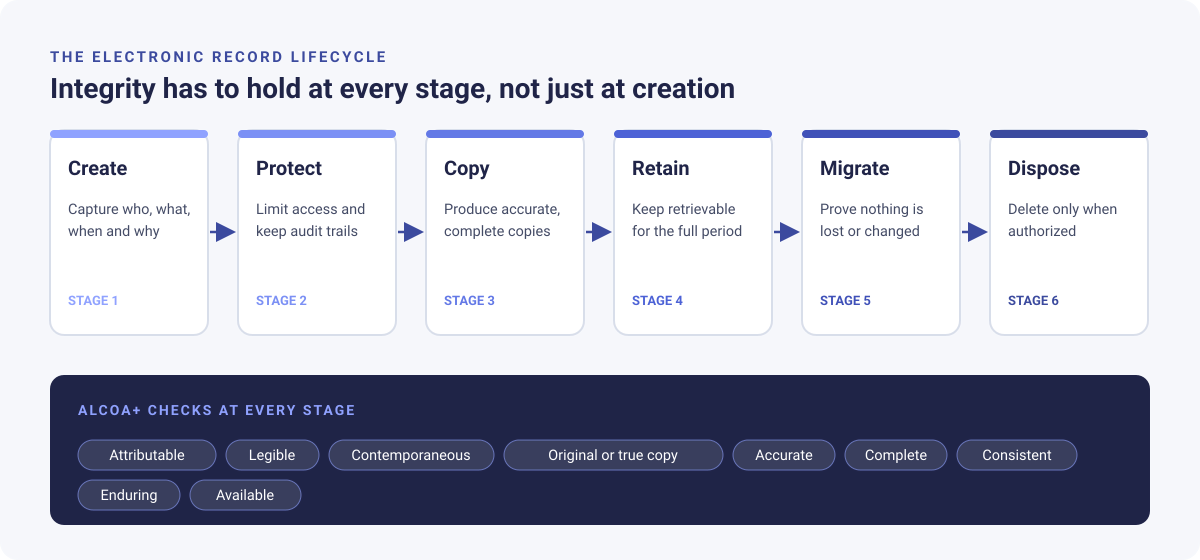
How do integrity controls work across the record lifecycle?
Integrity is not a property of storage alone. It has to hold at each stage, and each stage leaves its own evidence.
| Stage | Control | Evidence |
|---|---|---|
| Create | Unique users, system time stamps, required fields and signatures | Record, signature and audit trail entry |
| Review and approve | Status controls and locking so approved content cannot change silently | Approval record and version history |
| Protect | Access limited to authorized users, with audit trails for changes and deletions | Role records and audit trail |
| Copy and print | Accurate, complete copies that identify themselves as copies | Controlled copy and copy log |
| Retain | Storage that keeps records readable and retrievable for the retention period | Retention schedule and retrieval tests |
| Migrate | Verified transfer with checks that content and metadata are unchanged | Migration plan and reconciliation report |
| Dispose | Authorized, documented deletion after the retention period | Disposition approval and record |
How long must you keep electronic records?
There is no single period. Each record class has its own trigger and basis. FDA’s 21 CFR 211.180, for example, ties many drug records to the batch expiration date, while ISO 13485 leaves device record periods to the organization within what regulations require. Build a retention schedule that names the rule behind each period, and let the longest applicable requirement win. Audit trails follow the records they cover.
| Record class | Retention clock starts | Basis to check |
|---|---|---|
| Batch production and control records | Batch expiration date | 21 CFR 211.180 |
| Device history and quality records | Device release, kept for at least the device lifetime you define or regulations require | ISO 13485 clause 4.2.5, 21 CFR 820.35 |
| Controlled document revisions | When the revision is superseded or obsolete | Your procedure and applicable rules |
| Training records | When training is completed or the requirement ends | Applicable rules and your procedure |
| Electronic signatures and audit trails | Same as the record they cover | 21 CFR 11.10(e) |
This table shows how to structure a schedule. It states no periods of its own, so fill in the periods from the rules that apply to you.
What is the difference between backup and archive?
FDA’s data integrity guidance describes a backup as a true copy of the original record, including metadata, kept securely for the full retention period. It also says temporary copies made in case of a crash do not meet that requirement. Annex 11 expects regular backup with restore verified, and archived data checked for accessibility, readability and integrity.
| Topic | Backup | Archive |
|---|---|---|
| Purpose | Recover records after loss or damage | Keep records for the long term outside active use |
| What to verify | That a restore works and is complete | That records stay readable and retrievable |
| Evidence | Restore test results | Retrieval test results and an index |
| Risk to manage | Incomplete or untested copies | Format or system change that makes records unreadable |
How do you produce accurate and complete copies?
Section 11.10(b) requires copies that are accurate and complete, in human-readable and electronic form, that FDA can inspect, review and copy. Provide enough metadata and audit trail information for the copy to be meaningful. Printed and downloaded copies of controlled documents should identify themselves as copies, so nobody treats an outdated printout as current.
How do you keep records retrievable after a migration or upgrade?
Annex 11 says that when equipment or programs change, you must ensure and test the ability to retrieve archived data. Treat migration as a validated change, not a file copy.
- Define the scope, including metadata, audit trails and signatures
- Map source fields to target fields and document any transformation
- Reconcile record counts and sample records before and after
- Confirm audit trails and signature links are intact in the new system
- Keep the source available until the migration is accepted
See our computerized system validation guide for the validation side.
When can you delete an electronic record?
Only after the retention period, through an authorized and documented disposition. Pause disposition while an investigation, complaint or inspection is open, as good practice. FDA’s guidance also says that when a result is validly invalidated, the original data stays in the batch record with the investigation. Deleting data to hide a problem is a data integrity failure, and the audit trail should capture deletions.
How do you test electronic record integrity compliance controls?
Test in your configured system and keep the evidence. These scenarios pair an action with the expected result.
| Scenario | Expected result |
|---|---|
| Modify an approved record | Previous information stays traceable and the change is attributed |
| Attempt to delete a record that is within retention | The action is blocked or recorded, according to your controls |
| Print or download a controlled document | The copy identifies itself as a copy |
| Export a record with its audit trail | The copy is accurate and complete, with the history included |
| Retrieve a record from the oldest retention period | It is readable and complete |
| Restore from backup | Records, audit trails and signatures are complete and consistent |
| Migrate records to a new system | Counts reconcile and sampled records match the source |
| Approve disposition of expired records | Deletion is authorized, documented and limited to eligible records |
Who is responsible for electronic record integrity compliance?
You are. A vendor supplies the platform and its controls, but the regulated organization sets the retention schedule, approves disposition and proves records are retrievable.
| Activity | Vendor | Your organization |
|---|---|---|
| Platform controls for access, audit trail and signatures | Provides | Configures and tests |
| Hosting, backup and restore of a hosted system | Provides and describes | Confirms it meets your requirements |
| Retention schedule | Supports | Owns |
| Disposition approval | Supports | Owns |
| Migration and retirement | Supports | Owns, and validates |
| Periodic retrieval and restore checks | Supports | Owns |
What does retrieving a record years later look like?
A good test is to reconstruct one controlled SOP revision and its evidence long after approval.
| Question an inspector might ask | Evidence you should be able to produce |
|---|---|
| Which revision applied on a given date? | Version history and effective dates |
| Who approved it, and what did they sign? | Signature record with name, date, time and meaning |
| Has the approved content changed since? | Approval record with a content fingerprint, or a version comparison |
| What changed between revisions? | A comparison of versions |
| Who was trained on it? | Training records linked to the revision |
| Can we see the full history? | Audit trail with actor, action and time |
What are the most common electronic record integrity compliance failures?
| Failure | Control that prevents it |
|---|---|
| No written retention schedule | A schedule naming the rule and trigger for each record class |
| Backups never tested by restoring | Scheduled restore tests with recorded results |
| Printouts kept in place of dynamic originals | A defined original record for each record class |
| Metadata or audit trails dropped in migration | Migration validation that covers metadata and audit trails |
| Records unreadable after a system change | Archive checks and retrieval tests |
| Deletion without authorization | Disposition approval and audit trail review |
| Uncontrolled printed copies in use | Controlled copies marked as copies |
| Retention ends before the audit trail does | Audit trail retention tied to its records |
Electronic record integrity compliance checklist
Governance and retention
- ☐ Regulated record classes are inventoried
- ☐ The original record is defined for each class
- ☐ A retention schedule names the rule and trigger for each class
- ☐ Audit trail retention matches the records they cover
- ☐ Disposition is authorized and documented
Integrity controls
- ☐ Access is limited to authorized users
- ☐ Changes and deletions are recorded in an audit trail
- ☐ Approved records are locked against silent change
- ☐ Copies are accurate, complete and marked as copies
- ☐ Metadata is retained with the record
Backup, archive and retrieval
- ☐ Backups are tested by restoring
- ☐ Archived records are checked for readability
- ☐ Retrieval from the oldest period is tested
- ☐ Records stay retrievable after system changes
Migration and change
- ☐ Migrations are planned and validated
- ☐ Counts and sampled records are reconciled
- ☐ Audit trails and signatures survive the move
- ☐ System changes go through change control
An implementation readiness checklist, not a certification of regulatory compliance.
How do the five compliance controls fit together?
| Guide | Question it answers |
|---|---|
| Document version control and traceability | Which version applied, and what changed? |
| Electronic signature compliance controls | Who signed, what did they sign and why? |
| Audit trail compliance controls | What happened, and can we reconstruct it? |
| Computerized system validation compliance controls | How do we show the controls perform as intended? |
| Electronic record integrity compliance controls (this guide) | Will the records stay accurate, protected and retrievable for their full lifecycle? |
How does eLeaP support electronic record integrity compliance?
eLeaP QMS and LMS provide several controls that support record integrity. Based on the eLeaP QMS user guide:
- Document statuses such as Superseded, Obsolete and Cancelled show where each revision stands in its lifecycle, and content locks from In Review onward
- An Approval Snapshot records the approved revision, the approval date and a content fingerprint
- Printed and downloaded copies of documents carry a Controlled Copy watermark
- A version comparison shows what changed, with a PDF redline export
- Each document has an Activity History, and the system audit trail records actor, item, action, details, date and IP, with filters and download
- The LMS keeps an E-Signature Log that can be downloaded
Retention schedules, backup and restore arrangements, archiving and disposition depend on your configuration, hosting and procedures. Ask about them during a demo, and review the QMS with LMS integration for training records.
Which regulatory sources cover electronic record integrity compliance?
- 21 CFR Part 11, Electronic Records; Electronic Signatures
- 21 CFR 211.180, General requirements for records
- 21 CFR 211.68, Automatic, mechanical, and electronic equipment
- 21 CFR 820.35, Control of records
- FDA guidance: Part 11, Scope and Application
- FDA guidance: Data Integrity and Compliance With Drug CGMP, Questions and Answers
- EU GMP Annex 11: Computerised Systems (January 2011 version)
Electronic Record Integrity Compliance FAQs
What is electronic record integrity? It is the assurance that an electronic record is accurate, complete, protected and retrievable for its whole lifecycle, and that any change is visible and attributable.
What are the ALCOA principles? FDA describes data as attributable, legible, contemporaneously recorded, original or a true copy, and accurate, known as ALCOA. ALCOA+ is an industry extension that adds complete, consistent, enduring and available.
How long must electronic records be kept? It depends on the record class and the rule. For example, 21 CFR 211.180 ties many drug records to the batch expiration date. Name the rule and trigger for each class in a retention schedule.
Does Part 11 set a retention period? Part 11 requires records to be protected for accurate and ready retrieval throughout the retention period, but the period itself comes from the predicate rules.
What is the difference between backup and archive? A backup is a true copy kept securely so records can be recovered, and it should be verified by restoring. An archive keeps records for the long term and should be checked for readability and retrieval.
Is a printout a valid original record? Only if the printout is the original or a true copy. FDA says a printout of a dynamic record does not satisfy the requirement to keep original records.
What is a true copy? FDA describes it as a copy that preserves the content, meaning, metadata and static or dynamic nature of the original.
Do audit trails have to be retained? Yes. Section 11.10(e) requires audit trail documentation to be kept at least as long as the electronic records it covers and to be available for FDA review.
What should we verify when migrating records? Check that content, metadata, audit trails and signature links are unchanged, reconcile counts, sample records, and keep the source until the migration is accepted.
Can we delete electronic records after the retention period? Yes, through an authorized and documented disposition. Pause disposition while an investigation, complaint or inspection is open, as good practice.
Do cloud or SaaS records need the same controls? Yes. Where records are held in a hosted system, you still need to show they stay protected and retrievable, and confirm backup and retention arrangements with the supplier.
Does an LMS need record retention controls? If it holds training records and signatures you rely on for regulated activity, yes. Scale the controls to the records and the risk.
See electronic record integrity compliance controls in action
Records are only as trustworthy as the controls around them. eLeaP QMS and LMS bring document control, electronic signatures, audit trails and training records together. Schedule an eLeaP demo to see how records are protected and retrieved, and ask about retention and backup arrangements.
Last reviewed: November 2026.