Completion Is Not Competence: How to Prove Your People Are Qualified

A training record shows that a person finished a course. An auditor, customer, or insurer wants to know more: can this person do the job, who confirmed it, and is that still true today? Most organizations answer the first question well and the second with spreadsheets and good intentions. This article explains why that gap matters, what a defensible qualification record needs, and how eLeaP Skills Levels is built around it.
The completion trap
Most learning systems answer one question well: who finished what. That is useful, and easy to mistake for something it isn’t. A completed course shows training was delivered. It is not evidence that the person can perform the task, that anyone competent watched them do it, or that nothing has changed since.
Any workplace where mistakes are costly asks the harder question: manufacturing, aviation, healthcare, food production, energy, construction, logistics and financial services, to name a few. Regulated sectors have asked it for a long time, and life sciences is where the rules are most explicit. In US drug manufacturing, 21 CFR 211.25 requires that people have the education, training, and experience to perform their assigned functions, and that GMP training is given by qualified individuals on a continuing basis. Medical device manufacturers now work under FDA’s Quality Management System Regulation (QMSR), effective February 2, 2026, which incorporates ISO 13485:2016.
Training gaps still appear in enforcement actions. A 2026 review of FDA Warning Letters from GMP Compliance found the same training deficiencies cited repeatedly. One letter described an analyst with no documented laboratory or CGMP training. Another described a production operator with no training records for a batch that was distributed in the US.
These sources come from life sciences, but the question is the same wherever someone must be shown competent before working unsupervised: a forklift operator, a line technician, a lab analyst, a flight-line mechanic, a loan processor. None of them prescribes levels or signatures. They set the expectation, and your organization decides what qualification means for each task.
What a defensible qualification record needs
In any industry, a qualification record that holds up under scrutiny has four properties.
- It shows what the person actually did: completed courses, performed tasks, and passed practical assessments.
- A named person vouched for the result. A signature belongs to an individual, and the record shows who signed and when.
- The record reflects today. When retraining lapses, the qualification does not quietly stay on the books.
- You can reconstruct how the person reached their current standing, when, and who was involved, including when a level was lost and regained.
Completion reports tend to cover the first property. The others are often kept elsewhere, in paper sign-off sheets and spreadsheets, and records kept in separate places drift apart. That drift is what people find when they are asked to prove a qualification after the fact.
Two ways to measure a skill
eLeaP offers two ways to measure a skill, each answering a different question. Percentage mode builds a score out of 100 from course points, on-the-job training (OJT) records, and manual entries. It is the fastest way to see training progress across many skills at once. Levels mode records who is qualified: a level is earned only when its requirements are complete, and the required people have signed.
Use percentages for progress at a glance, and Levels for tasks where you need proof of qualification. An account uses one mode at a time, and you can switch between them whenever you like without losing anything already recorded.
The qualification ladder
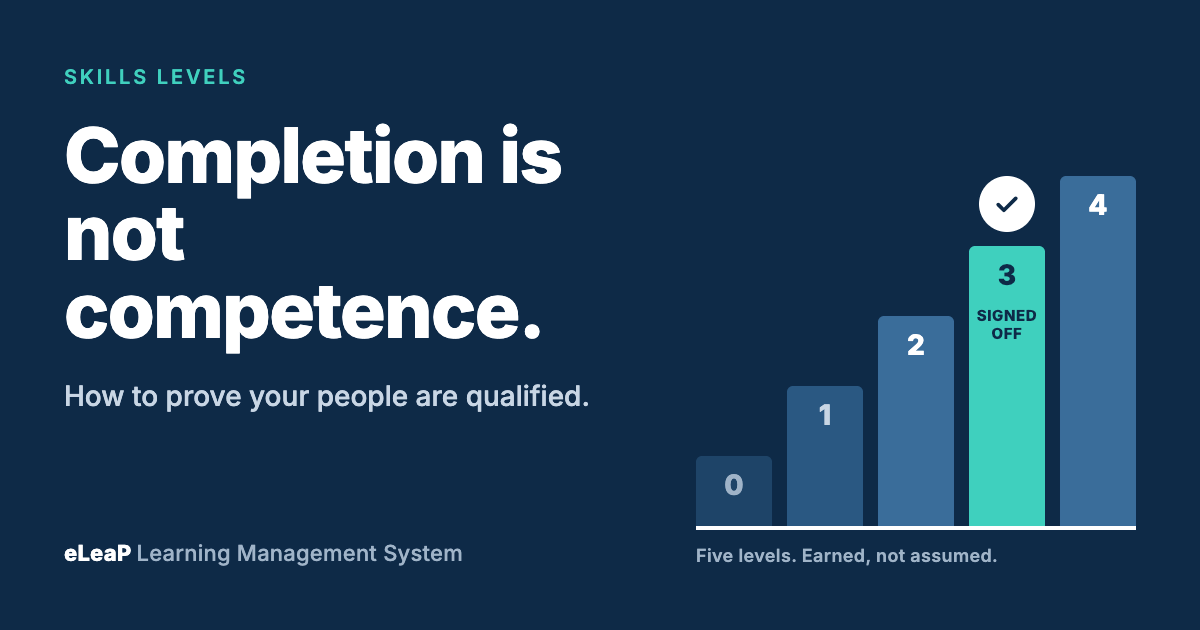
A level answers a different question than a score: what is this person cleared to do? Every skill in eLeaP has the same five levels. These are the default names, and you can rename any of them to match your own terminology.
| Level | Default name | What it means |
| 0 | Not Trained | Where everyone starts. Nobody earns Level 0. |
| 1 | In Training | The first level’s requirements are complete. |
| 2 | Can Perform With Supervision | The person can do the work with someone watching. |
| 3 | Qualified | Out of the box, needs a trainee and a trainer signature. |
| 4 | Qualified Trainer | Needs Level 3 plus trainer requirements. Out of the box, needs both signatures. |
Nobody is handed a level. A person moves up only by completing what each level requires, and you can’t reach a level with no requirements.
How Skills Levels delivers the four properties
Evidence comes from requirements you choose. For each skill level, you decide what it takes: a standard course, an assessment (an Observation Checklist where a trainer observes the work), an OJT task that a trainer records, or, for Level 4, a train-the-trainer course. Each course counts toward one level per skill, so finishing one course cannot carry someone straight to the top.
Attestation is a gate, not a formality. For each level, you decide whether the trainee, the trainer, or both must sign. Signatures use eLeaP’s e-signature under the signer’s own login, with no scanned images. If a level requires a signature, finishing the training isn’t enough, and the level isn’t recorded until the signatures are in place. Order doesn’t matter: if someone finishes first, the level is recorded when the last signature arrives, and the first signature simply waits.
Currency follows retraining. If a course is reset for annual retraining, the requirement is no longer met and the person’s level drops. When they complete it again, their higher levels are restored without signing again. Earlier signatures stay on record, so restored levels rest on previously given sign-offs.
Traceability is built in. Level History records every change with when it happened, the level it moved from and to, the reason, and who or what caused it. The history is append-only, so nothing in it is edited or removed.
An example: Forklift Operation
Take a skill called Forklift Operation. Jane is the trainee. Tom is her supervisor and the trainer who signs her off. This is an illustration, so swap in your own skill, courses, and people.
| Level | Jane must… | Signatures |
| 1 – In Training | Complete Forklift Safety Basics | None |
| 2 – Can Perform With Supervision | Complete Forklift Hands-On Practice | None |
| 3 – Qualified | Pass Forklift Practical Assessment, observed by Tom | Jane and Tom |
Jane starts at Level 0. Completing the first course moves her to Level 1, and completing the second moves her to Level 2. At that point, eLeaP emails the supervisors, managers, and coordinators of her user group that an observation assessment is ready. Tom observes her, completes the checklist, and e-signs as the observer. Jane is still at Level 2, because Level 3 needs both signatures. When she reviews the assessment and e-signs, she moves to Level 3 (Qualified). Her record shows every step.
Where the approach applies
The forklift example is deliberately ordinary. The ladder is the same in every industry; only the skills change.
- Manufacturing: operating a press, running a changeover, welding, using new equipment.
- Aviation: maintenance tasks, ground handling, and other work where a person is signed off before working without supervision.
- Healthcare and laboratories: clinical procedures, specimen handling, instrument use.
- Food and beverage: sanitation, allergen control, operating a production line.
- Energy, utilities and construction: hazardous equipment, lockout procedures, work in restricted spaces.
- Logistics and warehousing: forklifts, dangerous goods handling, loading and securing freight.
- Financial services and other office work: supervised sign-off for new staff on sensitive processes, approvals or systems.
If a task has a course, a practical check, and someone who has to vouch for the result, it fits a ladder.
Managing qualification at scale
At scale, the useful question changes from “is Jane qualified?” to “who is not?” Every skill list has a level filter with a “Below” option for each level, so “Below Qualified” shows everyone who has not yet reached Level 3, which is usually the list you want before an audit. A “Waiting for signature” status shows who has finished the requirements but still needs a signature. Level Templates let you define a shared progression once and reuse it across skills, and editing a template re-checks everyone on those skills, usually within a few minutes. Exports include both the level number and the level name.
Decisions to make before you adopt it
The software is the easy part. The decisions that make a ladder meaningful are yours.
- What each level means for each task. Names and requirements are yours to define. A level with no requirements cannot be reached.
- Who has the authority to sign. Decide, level by level, whether the trainee, the trainer or both must sign.
- Which skills deserve a ladder. Start where an error is costly, and keep percentages for the rest of your training progress.
- How your account is set up. An Administrator sets the mode for the whole account. Everyone starts at Level 0 and earns each level. Signature-gated levels are awarded only through a named person’s signature and never through the API, because an API token identifies your company, not an individual. OJT tasks count when a trainer or another authorized role submits the record.
Switching to Levels mode and back is reversible, so you can try it without losing your recorded percentages.
See it in action
Watch the Skills Levels tutorial for a walkthrough of setup and signing. Want to see it with your own skills and courses? Talk to us at eleapsoftware.com.