21 CFR Part 11 Compliance: How Learning Management Systems Enable FDA-Regulated Training

Understanding 21 CFR Part 11 in the Training Context
21 CFR Part 11 establishes FDA criteria for electronic records and electronic signatures in regulated environments. For life sciences organizations, this regulation fundamentally shapes how training documentation, qualification records, and compliance data must be managed.
The regulation requires that any electronic system used to maintain GxP-relevant records—including training records that demonstrate personnel qualification—must meet specific technical and procedural controls. This creates unique challenges for training departments that traditional paper-based systems or basic digital tools cannot address effectively.
Predicate Rules: Why Training Records Fall Under 21 CFR Part 11
Before implementing Part 11 controls, organizations must understand which training records require compliance. Part 11 applies when electronic records are used to satisfy predicate rule requirements—the underlying FDA regulations that mandate specific documentation.
Key Predicate Rules Requiring Training Documentation:
21 CFR 211.25 (Pharmaceuticals) – Personnel Qualifications:
- “Each person engaged in manufacture, processing, packing, or holding of a drug product shall have education, training, and experience to perform assigned functions”
- Requires documented evidence of training completion
- Mandates periodic GMP training updates
21 CFR 820.25 (Medical Devices) – Personnel:
- “Each manufacturer shall establish procedures for identifying training needs”
- Requires documented training on device-specific procedures
- Mandates effectiveness verification of training
21 CFR 606.20 (Blood Products) – Personnel:
- “Personnel must have capabilities commensurate with assigned functions”
- Requires initial and ongoing training documentation
- Mandates supervisor verification of competence
21 CFR 58.29 (Good Laboratory Practice) – Personnel:
- “Each individual engaged in the conduct of nonclinical laboratory studies shall have education, training, and experience”
- Requires maintenance of training records and job descriptions
When training records are created, modified, or maintained electronically to satisfy these predicate rules, the LMS must comply with 21 CFR Part 11. This establishes the regulatory foundation for system validation and control requirements.
ALCOA+ Principles for Training Data Integrity
The FDA expects all GxP data, including training records, to meet ALCOA+ principles. These internationally recognized criteria ensure data integrity throughout the record lifecycle:
Core ALCOA Principles
Attributable
- Every training record must identify who performed the action
- Electronic signatures must uniquely identify the individual
- Shared logins or generic accounts violate this principle
- Implementation: Individual user IDs with password protection
Legible
- Records must be readable and permanent
- System must prevent data obscuration or loss
- Display formats must be clear and understandable
- Implementation: High-resolution displays, printable formats, PDF archival
Contemporaneous
- Training must be recorded at time of completion
- Backdating or pre-dating records is prohibited
- System clock synchronization is critical
- Implementation: Automatic timestamps, NTP server synchronization
Original
- Preserve the first capture of data
- Maintain raw data alongside processed information
- Cannot replace original records with copies
- Implementation: Write-once audit trails, version control with history
Accurate
- Records must be error-free and complete
- Any corrections must be documented with reason
- System calculations must be validated
- Implementation: Input validation, calculation testing, error handling
Plus (+) Attributes
Complete
- All data and metadata must be retained
- Cannot selectively delete failed attempts
- Must include all retraining and reassessments
- Implementation: Comprehensive audit trails, no delete functions
Consistent
- Timestamps must follow standardized format
- Data must be recorded in the same sequence as activities
- File naming conventions must be systematic
- Implementation: System-enforced workflows, standardized formats
Enduring
- Records must be maintained throughout retention period
- Media migration must preserve data integrity
- Disaster recovery must ensure no data loss
- Implementation: Validated backup systems, archive procedures
Available
- Records must be retrievable for review and inspection
- System must support rapid search and reporting
- Cannot have single points of failure
- Implementation: Redundant systems, indexed databases, quick search
These principles apply to every aspect of training documentation, from initial enrollment through certificate generation. Organizations must design their LMS configuration and procedures to ensure consistent ALCOA+ compliance.
Global Compliance Framework: 21 CFR Part 11 and EU Annex 11
Harmonizing U.S. and European Requirements
Organizations operating globally must navigate both FDA’s 21 CFR Part 11 and the European Union’s Annex 11 to the EU GMP Guidelines. While these regulations share core objectives around data integrity and system reliability, understanding their nuances is critical for multinational compliance.
21 CFR Part 11 (FDA) emphasizes:
- Electronic signatures as legally binding equivalents to handwritten signatures
- Closed system controls with strong user authentication
- Computer-generated, time-stamped audit trails
- System validation for intended use
EU Annex 11 adds specific requirements for:
- Risk-based approach to validation (critical vs. non-critical systems)
- Detailed personnel responsibilities and training documentation
- System lifecycle management from design through retirement
- Business continuity and disaster recovery planning
- Periodic evaluation of system compliance status
Unified Compliance Strategy
A properly configured LMS can satisfy both frameworks simultaneously by implementing the most stringent requirement from each regulation. This approach ensures global compliance without maintaining separate systems for different regions.
Key harmonization points include:
- Implementing electronic signatures that meet both FDA’s legally binding requirements and EU’s attribution standards
- Maintaining audit trails that capture both U.S. regulatory requirements and EU’s emphasis on data criticality assessment
- Establishing validation protocols that satisfy FDA’s predicate rules and EU’s risk-based validation approach
Core Requirements for LMS Compliance
Electronic Records Management
Training records in FDA-regulated environments serve as critical quality system documentation. These records demonstrate that personnel possess required qualifications to perform regulated activities, from manufacturing processes to quality control procedures.
An LMS must maintain training records with complete data integrity throughout their retention period. This includes course completions, assessment results, qualification status, and retraining histories. The system must prevent unauthorized alterations while maintaining readily retrievable records for FDA inspection.
Electronic Signature Implementation
21 CFR Part 11 requires electronic signatures to be linked to their respective records, include user identification, and maintain signature manifestation visibility. In training contexts, this applies to multiple touchpoints: trainee acknowledgment of SOP understanding, supervisor verification of on-the-job training completion, and quality approval of training effectiveness.
Each signature must uniquely identify the signer and cannot be reused or reassigned. The system must clearly indicate the meaning of each signature (review, approval, verification) and maintain permanent association between signatures and their signed records.
Specific Technical Implementation:
- Two-factor authentication: While strictly not required, 2FA can help increase access security. This requires tools like Google Authenticator, Microsoft Authenticator or Authy.
- Session controls: Automatic timeout after 15-30 minutes of inactivity
- Re-authentication requirements: For e-signatures applied during a continuous session, and not necessarily required for other critical actions.
- Signature manifestation: Display of user name, date/time, and signature meaning
Audit Trail Requirements
Every FDA-regulated training system must maintain computer-generated, time-stamped audit trails that independently record user actions affecting electronic records. This includes course enrollment, content modifications, completion status changes, and administrative actions.
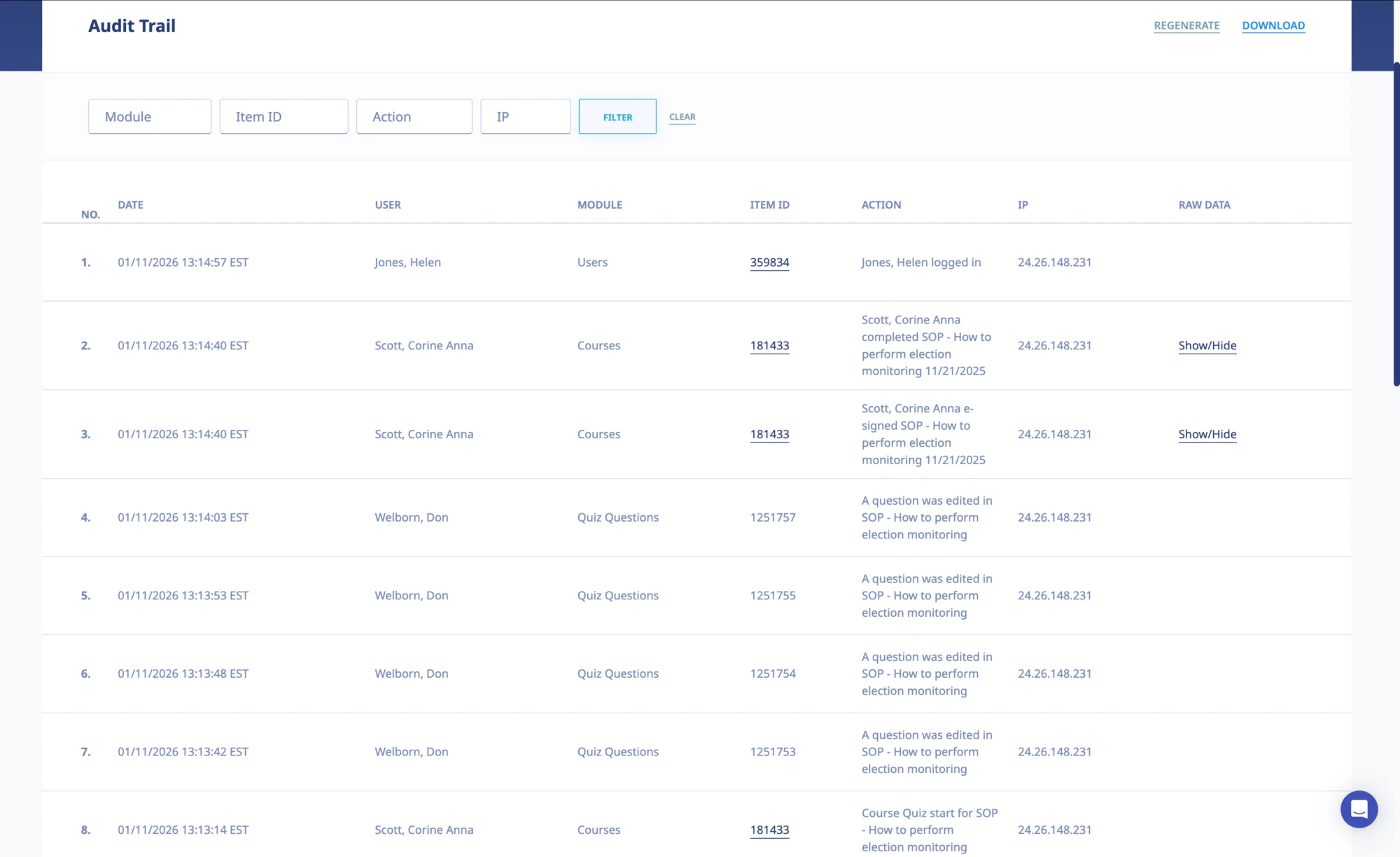
The audit trail must capture who performed each action, what changed, when it occurred, and in many cases, why the change was made. These trails must be secure, uneditable, and maintained for the same retention period as the associated records.
Audit Trail Technical Specifications:
- Granular tracking: Every create, read, update, delete (CRUD) operation
- Immutable logs: Write-once storage preventing modification
- Synchronized timestamps: NTP server synchronization for accuracy
- Searchable format: Ability to filter by user, date range, record type
- Export capabilities: Human-readable reports for inspection
Common Compliance Pitfalls to Avoid
Critical Mistakes That Lead to FDA Observations
Understanding common failures helps organizations proactively address vulnerabilities before they become regulatory findings:
- Shared User Accounts
- The Mistake: Using generic logins like “QC_User” or “Training_Admin”
- The Risk: Violates attribution requirements; cannot identify who performed actions
- The Solution: Individual accounts for every user, including temporary staff
- FDA Finding Example: “Firm failed to ensure electronic records were attributable to specific individuals”
- Lack of Revalidation After Updates
- The Mistake: Applying software patches or updates without impact assessment
- The Risk: Changes may affect validated state, compromising compliance
- The Solution: Change control process with risk-based revalidation
- FDA Finding Example: “System changes were not evaluated for impact on validated state”
- Inadequate Password Controls
- The Mistake: Weak passwords, no expiration, or password sharing
- The Risk: Unauthorized access to training records and potential data manipulation
- The Solution: Complex passwords, regular expiration, account lockout policies
- FDA Finding Example: “Password policies did not prevent unauthorized system access”
- Missing Audit Trails
- The Mistake: Disabling audit trails or failing to review them regularly
- The Risk: Cannot detect unauthorized changes or demonstrate data integrity
- The Solution: Always-on audit trails with periodic review procedures
- FDA Finding Example: “Audit trail functionality was disabled for administrative users”
- Incomplete Validation Documentation
- The Mistake: Missing test scripts, unsigned protocols, or outdated requirements
- The Risk: Cannot demonstrate system performs as intended
- The Solution: Complete validation package with traceability matrix
- FDA Finding Example: “Validation documentation did not demonstrate all critical functions were tested”
- Training Records Without Context
- The Mistake: Recording completion without version information or effectiveness verification
- The Risk: Cannot prove personnel trained on current procedures
- The Solution: Link training to specific document versions with effectiveness assessment
- FDA Finding Example: “Training records did not indicate which version of procedures was used”
- Hybrid System Gaps
- The Mistake: Inconsistent controls between paper and electronic systems
- The Risk: Incomplete records and compliance gaps
- The Solution: Unified procedures covering both systems with reconciliation
- FDA Finding Example: “No procedure to ensure consistency between electronic and paper training records”
- Inadequate Backup and Recovery
- The Mistake: Untested backups or no disaster recovery plan
- The Risk: Permanent loss of training records
- The Solution: Regular backup testing with documented recovery procedures
- FDA Finding Example: “Firm could not demonstrate ability to recover training records from backup”
- Unauthorized Deletions
- The Mistake: Allowing record deletion without documentation
- The Risk: Loss of required records and audit trail gaps
- The Solution: Remove delete capabilities or require documented justification
- FDA Finding Example: “System allowed deletion of training records without justification”
- Lack of Periodic Review
- The Mistake: “Set and forget” approach to validated systems
- The Risk: Compliance drift and undetected system issues
- The Solution: Scheduled periodic reviews with documented outcomes
- FDA Finding Example: “No evidence of periodic evaluation of system compliance status”
Technical Controls for Compliance
System Validation According to GAMP 5
Life sciences organizations must validate their LMS following Good Automated Manufacturing Practice (GAMP 5) guidelines, which provide a risk-based approach to computer system validation. This framework categorizes software and guides validation efforts accordingly.
GAMP 5 Category Classification for LMS:
- Category 3 (Non-configured products): Off-the-shelf LMS with no configuration
- Category 4 (Configured products): Configured LMS with workflow customization
- Category 5 (Custom applications): Heavily customized or bespoke LMS solutions
Validation Lifecycle Phases
Installation Qualification (IQ) Verifies the LMS infrastructure meets specifications:
- Server specifications and operating system verification
- Database installation and configuration
- Network connectivity and firewall settings
- SSL certificate installation and HTTPS enforcement
- Backup system configuration
- User directory integration (Active Directory/LDAP)
Operational Qualification (OQ) Confirms all functional requirements operate correctly:
- User authentication and password policy enforcement
- Role-based access control assignment
- Course creation and deployment workflows
- Assessment and quiz functionality
- Electronic signature capture and display
- Audit trail generation and retrieval
- Report generation across all templates
- Integration testing with HR/quality systems
Performance Qualification (PQ) Demonstrates consistent performance in production environment:
- Concurrent user load testing (normal and peak scenarios)
- Data migration accuracy from legacy systems
- Backup and recovery procedures
- Disaster recovery testing
- Long-term data retention verification
- Real-world workflow execution by actual users
Access Controls and Security
The regulation mandates restricted system access through unique user identification and password controls. Organizations must implement role-based permissions that limit users to authorized functions while maintaining segregation of duties where required.
Specific Security Controls Implementation:
Password Requirements:
- Minimum 8 characters with complexity rules
- Password history preventing reuse of last 5 passwords
- Password expiration every 60-90 days
- Account lockout after 3-5 failed attempts
- Temporary passwords requiring change on first login
Role-Based Access Matrix Example:
- System Administrator: Full system configuration, user management
- Training Administrator: Course creation, assignment, reporting
- Supervisor: Team member training approval, observation checklist completion
- Quality Reviewer: Read-only access to all training records
- Trainee: Course completion, personal record viewing
Data Integrity Safeguards
Training data must remain accurate, complete, and consistent throughout its lifecycle. This requires controls preventing data deletion, maintaining version control for updated content, and ensuring synchronized backup systems.
Technical Safeguards:
- Database encryption: AES-256 encryption at rest and in transit
- Automated backups: Daily incremental, weekly full backups
- Version control: Automatic versioning of all course content
- Data validation rules: Field-level constraints preventing invalid entries
- Checksum verification: MD5/SHA validation for file integrity
- Archive procedures: Compliant long-term storage with retrieval capability
Procedural Controls and SOPs
Training Administration Procedures
Organizations must establish written procedures governing LMS use, including user account management, course deployment processes, and record retention policies. These SOPs must define roles and responsibilities for training administrators, subject matter experts, and quality personnel.
Procedures must address training needs assessment, curriculum development with appropriate review cycles, and effectiveness verification methods. Each procedure requires version control and periodic review to ensure continued compliance.
Record Retention and Retrieval
FDA regulations specify minimum retention periods for different record types, often extending years beyond employee departure. The LMS must facilitate both routine retrieval for operational needs and rapid access during regulatory inspections.
Organizations must establish procedures for record archival, including migration plans for system transitions and disaster recovery protocols protecting against data loss.
Common Compliance Challenges
Hybrid Paper-Electronic Systems
Many organizations operate hybrid environments where some training occurs electronically while other components remain paper-based. These situations require careful procedural controls ensuring complete, synchronized records across both systems.
The challenge intensifies when organizations must demonstrate equivalence between electronic and paper records or manage transitions from legacy paper systems to electronic platforms.
Hybrid System Management Strategies:
- Define clear boundaries between paper and electronic processes
- Implement reconciliation procedures for cross-system records
- Maintain master index linking paper and electronic documentation
- Establish scanning/digitization procedures with quality checks
- Document retention policies covering both formats
Multi-Site Coordination
Global life sciences companies face complexity managing training across facilities with varying regulatory requirements. The LMS must accommodate different regional regulations while maintaining centralized oversight and reporting capabilities.
This includes managing time zone considerations for training deadlines, supporting multiple languages while maintaining record integrity, and coordinating validation efforts across sites.
Vendor and Contractor Training
Organizations must ensure external personnel accessing GxP areas receive appropriate training. This requires extending LMS access to non-employees while maintaining security and generating compliant records of their qualifications.
The system must differentiate between employee and contractor records, potentially with different retention requirements and access restrictions.
Implementation Best Practices
Risk-Based Approach
Organizations should apply risk assessment principles to determine appropriate control levels for different training types. Critical GxP training requiring extensive controls differs from general corporate training that may need minimal compliance measures.
Risk Assessment Matrix:
- High Risk: Direct patient impact (manufacturing, quality control)
- Medium Risk: Indirect GxP impact (warehouse, maintenance)
- Low Risk: Administrative functions (IT support, HR)
This targeted approach optimizes resource allocation while ensuring regulatory requirements are met where necessary.
Continuous Monitoring
Compliance requires ongoing system monitoring through periodic reviews, internal audits, and performance metrics. Organizations must establish key performance indicators for training completion rates, overdue training identification, and system availability.
Key Metrics to Monitor:
- Training completion rate by department/role
- Average time to complete required training
- System uptime and availability percentage
- Audit finding trends and corrective action effectiveness
- Password reset frequency and help desk tickets
- Failed login attempts and security incidents
Regular monitoring enables early detection of compliance gaps before they escalate into regulatory findings.
Inspector Readiness
The LMS must facilitate efficient regulatory inspections through readily accessible records, clear audit trails, and comprehensive reporting capabilities. Organizations should maintain inspection readiness through mock audits and defined data presentation procedures.
Inspection Preparation Checklist:
- Pre-configured inspector accounts with appropriate read-only access
- Standard reports for common inspection requests
- Quick reference guide for retrieving specific record types
- Validation summary binder with current status
- System demonstration scripts for key workflows
- Documented evidence of periodic review and monitoring
Training personnel on inspector interaction protocols and system demonstration ensures smooth regulatory encounters.
Integration with Quality Systems (eLeaP QMS)
Document Management Integration
Training records must align with controlled documents like SOPs and work instructions. When procedures change, the LMS must trigger retraining requirements and track completion before personnel perform modified processes.
This integration ensures training remains current with operational procedures and quality system requirements.
Deviation and CAPA Systems
Training gaps often contribute to quality events. The LMS should integrate with deviation management and CAPA systems to identify training-related root causes and track corrective action effectiveness.
This closed-loop approach strengthens the overall quality system while demonstrating proactive compliance management.
Platform-Specific Implementation Features
eLeaP LMS Compliance Capabilities
The eLeaP platform provides specific technical controls addressing 21 CFR Part 11 requirements:
Authentication and Access:
- Multi-factor authentication (MFA) support
- Configurable password complexity rules
- Automatic session timeout (customizable 5-60 minutes)
- IP restriction capabilities for additional security
- Integration with Active Directory/SSO providers
Electronic Signature Features:
- E-signature requirement settings per course
- Signature manifestation with user, timestamp, meaning
- Re-authentication for signature execution
- Signature binding to specific record versions
- Non-repudiation through cryptographic methods
Audit Trail Functionality:
- Automatic capture of all system activities
- Immutable audit logs with tamper detection
- Exportable reports for inspection
- Long-term archive capabilities
- Real-time monitoring dashboards
Validation Support:
- Pre-validated software modules
- Validation package with IQ/OQ/PQ templates
- Change control documentation
- Release notes for version updates
- Customer-specific validation support services
Future Considerations
As FDA guidance evolves and technology advances, organizations must maintain flexibility in their training systems. Cloud-based architectures, artificial intelligence applications, and mobile learning platforms introduce new compliance considerations requiring careful evaluation.
Computer Software Assurance (CSA)
The FDA’s shift from Computer System Validation (CSV) to Computer Software Assurance (CSA) emphasizes critical thinking over excessive documentation. This approach encourages:
- Risk-based testing focused on patient safety
- Leveraging vendor documentation and testing
- Reduced validation burden for low-risk features
- Continuous monitoring over periodic revalidation
Emerging Technologies
Organizations should evaluate new capabilities while maintaining compliance:
- AI-powered content creation: Validation of algorithm outputs
- Mobile learning: Device management and offline synchronization
- Virtual reality training: Data capture and completion verification
- Blockchain: Immutable record keeping potential
Conclusion
The key to sustained compliance lies in selecting an LMS designed specifically for regulated environments, maintaining robust procedural controls, and fostering a culture where compliance becomes integral to training operations rather than an added burden.
Success requires understanding that 21 CFR Part 11 compliance extends beyond software features to encompass procedural controls, validation documentation, and organizational commitment. By implementing comprehensive technical controls, following GAMP 5 validation guidance, adhering to ALCOA+ principles, and avoiding common pitfalls, organizations transform their LMS from a compliance requirement into a competitive advantage that ensures product quality and patient safety.