Learning Management Systems: What you need to know before choosing an LMS
Everything You Need to Know About Modern LMS Platforms for Corporate Training, Compliance, and Workforce Development
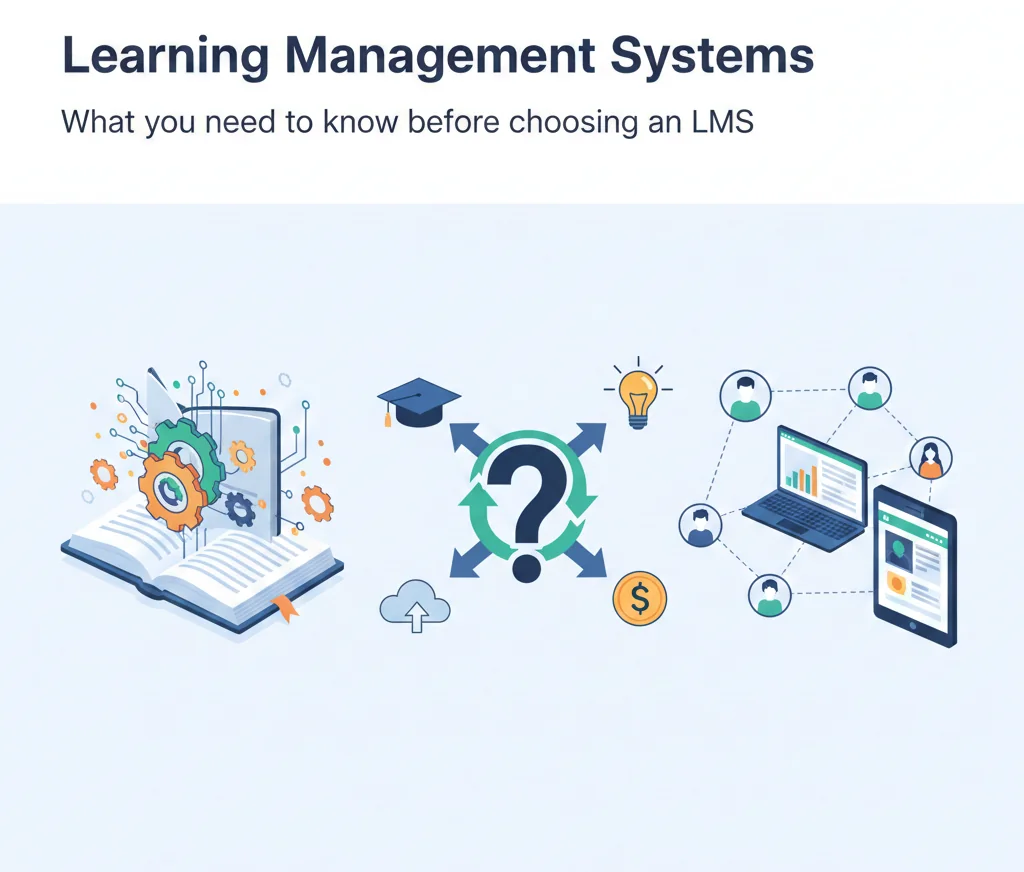
A Learning Management System (LMS) has become essential infrastructure for modern organizations, transforming how companies deliver training, ensure regulatory compliance, develop workforce capabilities, and measure learning effectiveness. In 2026, with the global LMS market exceeding $28 billion and adoption rates surpassing 90% in enterprise organizations, understanding what an LMS is, how it works, and how to leverage it effectively is critical for business success.
This comprehensive guide explains everything you need to know about learning management systems—from fundamental concepts and core capabilities to industry-specific applications, selection criteria, and emerging trends reshaping corporate learning.
What is a Learning Management System?
A Learning Management System is cloud-based or on-premise software that enables organizations to create, deliver, track, and manage training programs, educational courses, and professional development initiatives. Think of an LMS as a digital learning headquarters where all training activities—course creation, learner enrollment, content delivery, assessment, certification, and performance tracking—happen in one centralized platform.
Core Purpose and Functions
At its essence, an LMS serves three primary functions:
Content Management: The platform stores and organizes all training materials including courses, videos, documents, presentations, quizzes, assessments, and certifications. Course creators can develop interactive learning experiences using built-in authoring tools or upload content created in external programs. Version control ensures everyone accesses the most current training materials.
Delivery and Access: The LMS makes training available to learners whenever and wherever they need it. Modern cloud-based systems enable access from any internet-connected device—desktop computers, laptops, tablets, or smartphones—supporting today’s distributed and mobile workforces. Learners log in, see their assigned courses, complete training at their own pace, and track their progress.
Tracking and Reporting: Perhaps the most valuable LMS capability is comprehensive tracking of all learning activity. The system automatically records who completed which training, when they finished, how long it took, quiz scores, certification status, and much more. Administrators can generate reports showing compliance rates, skill gaps, training effectiveness, and learning outcomes.
How Learning Management Systems Work
Understanding the LMS workflow helps clarify how these platforms create value:
Administration: Administrators configure the system, create organizational hierarchies, define user roles, establish permissions, and customize settings to match company needs.
Course Creation: Instructional designers, subject matter experts, or administrators create training courses using the LMS’s built-in authoring tools or upload content developed in external programs like Articulate, Adobe Captivate, or Camtasia.
User Management: HR teams or administrators add employees to the system (often automatically via integration with HRIS systems), assign them to appropriate groups or departments, and define their learning requirements.
Course Assignment: Courses are assigned to learners based on job roles, departments, compliance requirements, skill gaps, or manager requests. The LMS can automate assignments using rules and triggers.
Learning: Employees log into the LMS, see their assigned training, complete courses on their schedule, take assessments, and earn certifications. The platform tracks everything automatically.
Assessment: Built-in quizzes, tests, and competency evaluations measure knowledge retention and skill development. Passing scores trigger certification awards or advancement to next learning levels.
Reporting: Managers, administrators, and compliance teams access real-time dashboards and detailed reports showing completion rates, assessment results, certification status, and learning trends.
Continuous Improvement: Analytics reveal which courses are most effective, where learners struggle, what content needs updating, and how training impacts business outcomes, enabling data-driven refinement.
Why Organizations Need a Learning Management System
The shift from traditional classroom training to digital learning management represents more than technological change—it’s a fundamental transformation in how organizations develop workforce capabilities and maintain competitive advantage.
Business Benefits Driving LMS Adoption
Compliance and Regulatory Adherence: For organizations in regulated industries—pharmaceuticals, biotechnology, medical devices, aviation, healthcare, financial services, manufacturing—training compliance is mandatory, not optional. An LMS automates tracking of regulatory training requirements, sends automatic reminders before certifications expire, maintains complete audit trails, and generates inspection-ready reports. This is particularly critical for FDA 21 CFR Part 11 compliance, FAA 14 CFR requirements, ISO certifications, and OSHA safety standards.
Cost Reduction: Traditional instructor-led training incurs significant costs: instructor fees, facility rentals, travel expenses, printed materials, employee time away from work, and opportunity costs from production disruption. LMS platforms eliminate or dramatically reduce these expenses. Organizations typically achieve 40-60% cost reduction transitioning from classroom to online training while often improving learning outcomes.
Scalability: As companies grow, hire new employees, open new locations, or expand internationally, training must scale accordingly. LMS platforms accommodate unlimited growth without proportional cost increases. Adding 10 employees or 1,000 requires the same platform with minimal incremental cost—just additional user licenses.
Consistency: Without an LMS, training quality varies by instructor, location, and timing. Critical information gets omitted, outdated procedures persist, or different sites receive contradictory instruction. An LMS ensures every learner receives identical, current training regardless of when or where they access it.
Flexibility and Accessibility: Modern workforces are distributed, mobile, working shifts, and operating across time zones. LMS platforms enable “learn anywhere, anytime” access from any device. Employees can complete required training during night shifts, on weekends, from home, or while traveling—dramatically improving completion rates compared to scheduled classroom sessions.
Performance Improvement: Research consistently shows that accessible, personalized, bite-sized training improves job performance faster than traditional methods. LMS platforms enable just-in-time learning when employees need specific skills, personalized learning paths matching individual development needs, and microlearning modules that improve knowledge retention.
Data-Driven Decisions: LMS analytics transform training from subjective judgment to data-driven strategy. Organizations can measure ROI of training investments, correlate learning with business outcomes, identify which courses drive performance improvement, and optimize training programs based on evidence rather than assumptions.
Essential LMS Features and Capabilities
Not all LMS platforms offer identical capabilities. Understanding essential features helps organizations evaluate options effectively.
Core Learning Management Features
Course Creation and Authoring: Modern LMS platforms include intuitive course building tools featuring WYSIWYG (what you see is what you get) editors, drag-and-drop interfaces, pre-built templates, and support for diverse content types—video, audio, documents, presentations, interactive exercises, simulations, and SCORM-compliant packages. AI-assisted content creation is increasingly common, helping generate quiz questions, summaries, and learning objectives.
Content Library Management: Robust organization systems enable categorization, tagging, versioning, and searchability of training materials. Course versioning ensures training aligns with current procedures—critical when SOPs change and retraining is required. Content libraries often include pre-built courses on common topics (safety, compliance, soft skills) plus custom organizational content.
User and Group Management: Administrators can create user accounts individually or in bulk, organize users into departments/teams/locations, assign roles and permissions, manage hierarchies reflecting organizational structure, and define who can access which content. Integration with HRIS systems automates user provisioning and deactivation.
Learning Paths: Sequential course delivery guides learners through structured development programs. Prerequisites ensure foundational knowledge before advanced topics. Learning paths support onboarding programs, certification tracks, career development, and compliance curriculum. Adaptive learning paths adjust based on individual performance and progress.
Assessments and Quizzes: Comprehensive testing capabilities include multiple question types (multiple choice, true/false, matching, fill-in-blank, essay, file upload, hotspot), question banks for randomization, customizable passing scores, immediate feedback options, unlimited retries or restrictions, time limits, and anti-cheating measures. Grading can be automatic or manual for subjective responses.
Certifications and Credentials: Automatic certificate generation upon course completion, customizable certificate designs, digital badge programs, certification expiration tracking, automatic renewal reminders, continuing education unit (CEU) management, and professional license tracking. Certificates can include verification codes for authenticity.
Mobile Learning: Native mobile applications for iOS and Android, responsive web design adapting to any screen size, offline content access for locations without connectivity, automatic synchronization when reconnected, and mobile-optimized assessments. Mobile accessibility is now expected, not optional.
Gamification: Points, badges, leaderboards, achievements, levels, and challenges increase learner engagement and motivation. Competitive elements can drive completion rates while making learning more enjoyable. Gamification is particularly effective for voluntary learning and skill development programs.
Social Learning: Discussion forums, peer-to-peer messaging, collaborative projects, shared notes, file sharing, and integration with communication platforms (Slack, Microsoft Teams) enable knowledge sharing and community building. Social learning reinforces formal training with informal knowledge exchange.
Administrative and Management Capabilities
Advanced Reporting and Analytics: Real-time dashboards showing training status, completion trends, compliance rates, and at-risk learners. Custom report builders creating tailored views for different stakeholders. Scheduled reports delivered automatically via email. Export capabilities to PDF, Excel, CSV for further analysis. Predictive analytics identifying learners likely to struggle or fail to complete.
Automation and Workflows: Automatic course assignments based on job roles, hire date, or manager approval. Triggered reminders as deadlines approach or certifications expire. Escalation workflows when training isn’t completed. Approval processes for course publication or enrollment. Integration-triggered actions (new hire in HRIS → automatic onboarding course assignment).
Compliance Management: Regulatory requirement tracking across different regulations (FDA, FAA, OSHA, industry-specific), mandatory training enforcement, audit trail generation showing who completed what training when, inspector-ready reports, electronic signature capture for acknowledgments, and change-driven retraining workflows.
Multi-Language Support: Interface localization in 20-50+ languages, content translation capabilities, right-to-left language support, region-specific date/time/number formatting. Essential for multinational organizations ensuring consistent training across geographies.
Branding and Customization: White-labeling removing vendor branding, custom color schemes and logos, configurable landing pages and dashboards, custom fields for organization-specific data, and theming options matching corporate identity.
Integration and Technical Capabilities
System Integrations: Pre-built connectors or APIs enabling integration with:
- HRIS (Workday, BambooHR, ADP, SAP SuccessFactors) for user management
- Single Sign-On (Azure AD, Okta, Google, OneLogin) for seamless authentication
- Quality Management Systems for SOP-driven training
- Document Management Systems linking procedures to required training
- Video Conferencing (Zoom, Teams, Webex) for instructor-led sessions
- CRM systems for customer/partner training
- Communication platforms (Slack, Teams) for notifications
Standards Compliance: Support for e-learning standards ensuring content interoperability:
- SCORM (Sharable Content Object Reference Model) 1.2 and 2004
- xAPI (Experience API) / Tin Can API for advanced tracking
- cmi5 for cloud-based learning
- AICC (Aviation Industry CBT Committee)
- LTI (Learning Tools Interoperability)
Security and Data Protection: Enterprise-grade security including data encryption at rest and in transit, secure authentication, role-based access controls, session management, IP whitelisting, audit logging, SOC 2 Type 2 certification, GDPR compliance, penetration testing, and vulnerability management.
Types of Learning Management Systems
LMS platforms deploy in different ways serving different purposes. Understanding types helps match solutions to organizational needs.
Deployment Models
Cloud-Based / SaaS LMS: Hosted on vendor servers and accessed via internet browsers. No hardware or infrastructure required. Vendor manages maintenance, updates, security, and backups. Subscription pricing (monthly or annual). Fastest deployment (days to weeks). Automatic feature updates. 95%+ of modern LMS deployments are cloud-based. Examples: eLeaP, Docebo, Absorb LMS, TalentLMS.
On-Premise LMS: Installed on organization’s own servers and infrastructure. Complete control over data, customization, and configuration. Organization responsible for maintenance, updates, security, and disaster recovery. Higher upfront capital costs. Longer implementation timelines. More common in highly regulated industries with data sovereignty concerns or organizations with existing data center investments.
Self-Hosted Cloud: Hybrid approach where organization controls cloud infrastructure (AWS, Azure, Google Cloud) but hosts LMS themselves. More control than SaaS with scalability of cloud. Requires technical expertise to manage. Less common than pure SaaS or on-premise.
Purpose-Based LMS Categories
Corporate LMS: Designed for employee training, onboarding, professional development, and compliance. Emphasizes integration with HR systems, role-based learning, manager oversight, and business analytics. Often includes extended enterprise capabilities for training partners, customers, or franchisees.
Academic LMS: Built for educational institutions managing student courses, grades, assignments, collaboration, and academic programs. Different feature priorities than corporate LMS. Examples: Canvas, Moodle, Blackboard.
Training Company LMS: Platforms for organizations selling training commercially. Include e-commerce capabilities, public course catalogs, multiple instructor support, affiliate programs, and revenue reporting. Often combined with marketing automation.
Compliance LMS: Specialized for industries with heavy regulatory requirements. Built-in audit trails, electronic signatures, validation documentation, inspection-ready reporting, and regulatory-specific workflows. Focus on FDA, FAA, OSHA, financial services, healthcare compliance.
Extended Enterprise LMS: Platforms training external audiences—customers, partners, distributors, franchisees, vendors. Multi-tenant architecture supporting separate branded instances, external user management, partner portal access, and usage reporting.
Learning Management Systems by Industry
While LMS platforms serve all industries, certain sectors have unique requirements shaping platform selection and use.
Life Sciences: Pharmaceuticals, Biotechnology, Medical Devices
Organizations in life sciences face stringent FDA regulation requiring validated systems, complete audit trails, electronic signature controls, and inspection-ready documentation.
Regulatory Requirements:
- FDA 21 CFR Part 11 compliance for electronic records and signatures
- GMP (Good Manufacturing Practice) training
- SOPs changes triggering mandatory retraining
- Qualification and competency management
- Validation documentation (IQ/OQ/PQ)
Critical LMS Features:
- Immutable audit trails tracking all training changes
- Electronic signature capabilities with two-factor authentication
- Course version control linking training to specific SOP versions
- Observation checklists for hands-on competency assessment
- Integration with quality management systems
- Pre-built validation packages reducing implementation time
eLeaP specializes in FDA-regulated industries, providing pre-validated platforms with comprehensive documentation enabling 2-4 week validation rather than 3-6 month projects typical for non-specialized systems.
Aviation: Airlines, Maintenance, Operations
FAA regulations mandate extensive training documentation, certification tracking, and recurrent training management.
Regulatory Requirements:
- FAA 14 CFR Parts 61, 91, 135, 145 compliance
- Pilot certification and currency tracking
- Maintenance technician qualification
- Recurrent training automation
- Training record retention
Critical LMS Features:
- Certification expiration monitoring with automatic alerts
- Recurring course assignment at specified intervals
- Multi-signature approval workflows
- Complex competency matrices
- Integration with scheduling and operations systems
Manufacturing: Industrial, Automotive, Electronics
Manufacturing organizations balance safety training, quality requirements, process training, and continuous improvement.
Training Needs:
- Safety and OSHA compliance
- Quality system requirements (ISO 9001, AS9100, IATF 16949)
- Equipment operation and maintenance
- Continuous improvement methodologies
- Standard work and procedure training
Critical LMS Features:
- Multi-language support for diverse workforces
- Mobile access for shop floor learning
- Competency matrices by role and process
- Integration with manufacturing execution systems
- Skills gap analysis and development planning
Healthcare: Hospitals, Clinics, Long-Term Care
Healthcare providers manage clinical competencies, accreditation requirements, patient safety, and continuing education.
Training Requirements:
- Joint Commission and accreditation compliance
- Clinical competency validation
- Continuing Medical Education (CME) and Nursing (CNE)
- HIPAA and patient privacy
- Infection control and safety
Critical LMS Features:
- CME/CNE credit tracking and reporting
- Clinical skills assessment tools
- Credential management
- Automatic license expiration alerts
- Integration with credentialing systems
Financial Services: Banking, Insurance, Investment
Heavily regulated industry with mandatory compliance training, certification requirements, and frequent regulatory changes.
Regulatory Requirements:
- FINRA, SEC, state insurance licensing
- Anti-money laundering (AML)
- Know Your Customer (KYC)
- Data privacy and security
- Product knowledge certification
Critical LMS Features:
- Exam proctoring and security
- Audit trails for compliance tracking
- Rapid content updates for regulatory changes
- Third-party compliance training integration
- Reporting for multiple regulatory bodies
Selecting the Right Learning Management System
With over 1,000 LMS platforms available, systematic evaluation is essential. Organizations should follow structured selection processes.
Define Requirements and Objectives
Start by clarifying what you need the LMS to accomplish:
Primary Use Cases: Employee onboarding, compliance training, skill development, certification programs, customer training, partner enablement?
Stakeholder Needs: What do learners need? Administrators? Compliance teams? Executives? HR?
Regulatory Requirements: FDA Part 11? FAA regulations? ISO certifications? HIPAA? Industry-specific compliance?
Success Metrics: Completion rates? Time to competency? Inspection readiness? Cost per learner? Performance improvement?
Integration Needs: Must connect with HRIS? QMS? SSO? What data should sync automatically?
Essential Evaluation Criteria
Regulatory Compliance Support: For regulated industries, this is non-negotiable. Evaluate audit trail capabilities, electronic signature controls, validation documentation availability, and vendor’s regulatory expertise.
Ease of Use: Both learner interface and administrative tools must be intuitive. Complex systems decrease adoption and increase support burden. Request trial access for hands-on evaluation.
Content Creation Tools: Assess built-in authoring capabilities, supported content formats, template availability, and AI-assisted creation features.
Reporting and Analytics: Examine pre-built reports, custom report creation, real-time dashboards, scheduled reporting, and data export capabilities.
Scalability: Ensure the platform can grow with your organization. Check user limits, concurrent access capacity, storage limits, and performance under load.
Mobile Capabilities: Verify native app availability, offline access, responsive design quality, and mobile assessment functionality.
Integration Capabilities: Review pre-built integrations, API documentation, webhook support, and technical requirements for custom integrations.
Security: Confirm data encryption, authentication methods, SOC 2 certification, penetration testing frequency, and disaster recovery procedures.
Customer Support: Investigate support hours, response time commitments, available channels (phone, email, chat), and knowledge base quality.
Vendor Stability: Research years in business, customer base size, financial backing, development momentum, and customer retention rates.
Pricing Model: Understand total cost including licenses, implementation, training, support, upgrades, and any hidden fees. Compare 3-5 year total cost of ownership.
Implementation Considerations
Timeline Expectations:
- Cloud LMS: 2-8 weeks typically
- On-premise LMS: 3-6 months typically
- Validation for regulated industries: Add 2-4 weeks (with vendor support) or 3-6 months (without)
Change Management: Plan for user communication, training programs, executive sponsorship, and addressing resistance.
Data Migration: Existing training records, user data, course content may need transfer. Assess migration support and tools.
Ongoing Administration: Estimate time required for course updates, user management, reporting, and system configuration.
Emerging Trends Shaping Learning Management Systems in 2026
The LMS landscape continues evolving rapidly. Understanding emerging trends helps future-proof platform selection.
Artificial Intelligence and Machine Learning
Content Recommendations: AI analyzes learner behavior, role, skills, and goals to suggest relevant courses, creating personalized learning journeys without manual programming.
Adaptive Learning: Platforms adjust content difficulty, pacing, and format based on individual learner performance, optimizing outcomes for diverse learning styles.
AI-Assisted Content Creation: Generative AI helps create quiz questions, summarize content, generate learning objectives, translate materials, and simplify complex text.
Predictive Analytics: Machine learning identifies learners at risk of non-completion, predicts skill gaps before they impact performance, and forecasts training needs based on business trends.
Chatbots and Virtual Assistants: AI-powered support answers learner questions, guides course selection, troubleshoots issues, and provides 24/7 assistance.
Microlearning and Bite-Sized Content
Traditional hour-long courses give way to 3-10 minute focused modules addressing specific skills or concepts. Microlearning improves knowledge retention, fits into workflow, reduces disruption, and enables just-in-time learning when employees need specific information.
Video-Based and Interactive Content
Video dominates content delivery, with interactive elements like clickable hotspots, branching scenarios, in-video quizzes, and simulations increasing engagement beyond passive watching. Screen recording and webcam capture democratize video content creation.
Skills-Based Learning and Competency Management
Organizations shift from course-centric to skills-centric approaches. LMS platforms increasingly include skills taxonomies, competency frameworks, skills gap analysis, personalized development plans, and skills-based credentials.
Learning in the Flow of Work
Integration with collaboration tools, embedded learning widgets, browser extensions, and just-in-time micro-resources deliver training exactly when needed rather than in scheduled sessions. This approach reduces time away from work while improving application.
Extended Reality (VR/AR)
While still emerging, virtual and augmented reality create immersive training experiences for complex procedures, hazardous situations, equipment operation, and soft skills practice impossible or impractical in real environments.
Social and Collaborative Learning
Peer-to-peer knowledge sharing, community-driven content, social media-style interactions, user-generated content, and mentoring platforms supplement formal training with informal learning networks.
eLeaP: Purpose-Built LMS for Regulated Industries
While hundreds of LMS platforms serve general corporate training, eLeaP has specialized exclusively in FDA and FAA regulated industries for 19 years. This focus delivers distinct advantages for life sciences, aviation, and manufacturing organizations.
Regulatory Compliance Built-In
eLeaP’s architecture incorporates 21 CFR Part 11 and 14 CFR requirements from the ground up:
- Immutable audit trails meeting FDA inspection standards
- Electronic signatures with two-component authentication
- Complete validation documentation (IQ/OQ/PQ)
- Inspection-ready reporting
- Course version control and change tracking
- Observation checklist assessments for hands-on competency
Accelerated Validation Process
Comprehensive validation packages eliminate 75% of typical validation effort:
- Pre-written Installation Qualification protocols
- Complete Operational Qualification test scripts
- Performance Qualification scenarios
- Traceability matrices
- Risk assessments and validation summary reports
- 2-4 week validation timelines vs. 3-6 months for platforms without support
Industry Expertise and Track Record
- 19+ years serving regulated industries exclusively
- 100% FDA inspection success rate (zero Part 11 findings)
- Pre-built GMP, GDP, GLP, GCP training templates
- FAA Part 135 and Part 145 compliance support
- ISO 13485 alignment
- Dedicated regulatory implementation specialists
Enterprise-Grade Cloud Platform
- SOC 2 Type 2 certified
- 9% uptime SLA
- Geographic redundancy
- HIPAA compliant
- Data encryption at rest and in transit
- Daily automated backups
Proven Results
- 60% reduction in training administration time
- 95%+ training completion rates
- Rapid deployment (2-4 weeks including validation)
- Seamless multi-site rollout
- Immediate inspection readiness
Conclusion: The Strategic Importance of LMS
Learning Management Systems have evolved from nice-to-have training tools to strategic business infrastructure. Organizations leveraging modern LMS platforms gain competitive advantages through:
- Rapid workforce development and skill deployment
- Regulatory compliance with minimal administrative burden
- Consistent training quality across all locations
- Data-driven learning optimization
- Significant cost savings vs. traditional training
- Scalable growth without proportional training cost increases
For FDA and FAA regulated organizations, specialized LMS platforms purpose-built for compliance requirements eliminate validation complexity while ensuring inspection readiness.
Selecting the right LMS requires understanding your specific needs, evaluating platforms against comprehensive criteria, and partnering with vendors who bring industry expertise aligned with your challenges.
Ready to explore how eLeaP’s specialized LMS serves regulated industries?
- Schedule a compliance-focused consultation
- Download our LMS Selection Guide for Regulated Industries
- Start your free 30-day trial
Here are four articles to help you select the best Learning Management System for your needs: How to Implement an LMS, Part 1: Laying the Groundwork, How to Implement an LMS, Part 2: The Analysis Phase, How to Implement an LMS, Part 3: Analysis Questions to Ask, How to Implement an LMS, Part 4: The Vendor Search.
eLeaP delivers enterprise learning management systems purpose-built for FDA and FAA regulated industries, with 19 years of regulatory expertise, comprehensive validation support, and proven inspection success.