GMP LMS: Learning Management for GMP Compliance
Version-Controlled SOP Training, Audit-Ready Records, and CAPA-Linked Retraining Workflows

GMP LMS: Learning Management Built for Good Manufacturing Practice Compliance
Pharmaceutical manufacturers operating under 21 CFR Part 210/211 or EU GMP Annex 11 don’t have a generic training problem — they have a compliance infrastructure problem. Regulators don’t just expect employees to complete training. They expect manufacturers to demonstrate, with documented evidence, that every person performing a regulated task has been trained on the current version of the relevant procedure, that the training was appropriate to their role and qualification level, that records are accurate and tamper-evident, and that when something changes — a procedure revision, a CAPA, a process deviation — the right people are retrained before they return to that task. See how eLeaP does this.
A generic LMS can deliver content and track completions. It cannot manage the compliance logic underneath those completions. This distinction is what separates a GMP LMS from every other platform on the market — and it’s where most pharma manufacturers discover their training infrastructure has a fundamental gap.

What GMP Training Requirements Actually Mandate
The training obligations under 21 CFR Part 211.68 and 211.192, and the broader cGMP framework, are not satisfied by completion certificates alone. The regulatory intent is that training protects product quality by ensuring personnel competence — and that intent translates into specific, auditable requirements.
SOPs and the current-version requirement. Under 21 CFR Part 211.68, employees must be trained on the procedures governing their work. The critical word is current. When a procedure is revised through change control, employees performing that task must be trained on the new version before resuming work. A training record pointing to a superseded SOP version is not a compliant record — it is a Form 483 observation waiting to be written.
Role-based training matrices. GMP does not require every employee to be trained on every procedure. It requires that the right employees are trained on the right procedures for their specific roles and work environments. This demands a structured training matrix: a documented map of which job functions require which training items, at what frequency, and to what level of assessment. Without a maintained training matrix, manufacturers cannot demonstrate at inspection that training coverage is systematically managed.
Qualification records and competency documentation. For personnel performing critical operations — validation activities, sterile manufacturing, analytical testing, calibration — training completion alone is often insufficient. Qualification records must demonstrate that the individual has the knowledge, skills, and demonstrated ability to perform the task. An LMS in a GMP environment must support competency-based assessments, not just acknowledgment signatures.
Retraining triggered by change control and deviations. This is where most training management systems break down. Change control processes generate retraining requirements — every procedure revision affecting personnel must flow into the training system as an assigned training event for the appropriate job functions. Similarly, CAPA processes routinely identify inadequate training as a root cause, requiring targeted retraining with documented verification. If your LMS is not connected to your change control and CAPA workflows, those retraining requirements must be manually entered — and manual handoffs fail.
Resource: FDA 21 CFR Part 211 — Current Good Manufacturing Practice for Finished Pharmaceuticals
How a GMP-Compliant LMS Differs from a Generic Platform
Most LMS platforms are built for corporate L&D: content libraries, completion tracking, and manager dashboards. These are useful capabilities. They are not sufficient for GMP compliance, and using them in a regulated environment without understanding the gaps creates regulatory risk rather than mitigating it.
Audit Trail Requirements
Under 21 CFR Part 11, electronic records used in regulated activities must include a complete, time-stamped audit trail that captures every action taken on a record — completion, modification, deletion, and access. The audit trail must be computer-generated, not user-modifiable, and must be available for FDA review.
A GMP LMS must generate audit trails that capture: training assignments, completions, assessment scores, completion dates and timestamps, and any modifications to training records with attribution to the specific user who made the change. If an inspector asks to see the training record for an employee who performed a specific operation on a specific date, the system must be able to produce that record with a complete, unbroken chain of custody.
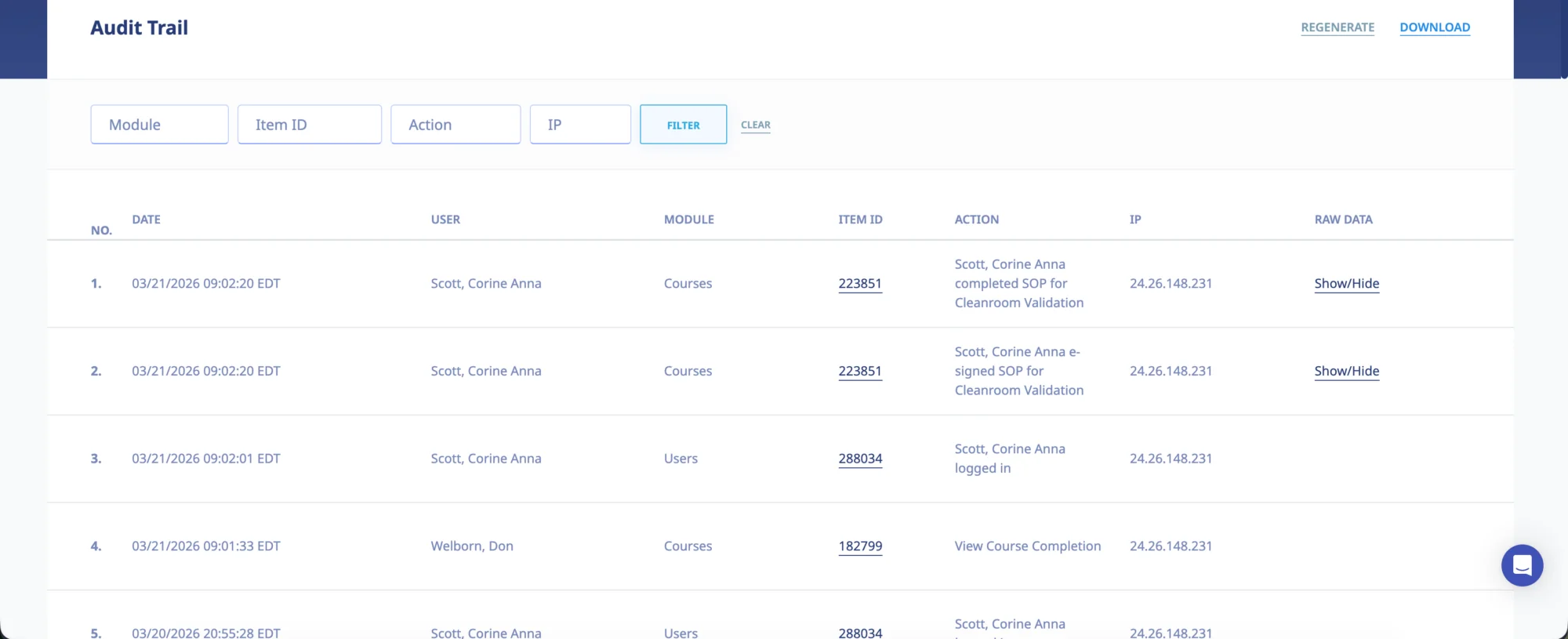
Generic LMS platforms often have completion logs. They rarely have the tamper-evident, attribute-linked audit trail architecture that 21 CFR Part 11 requires.
Controlled Access and Electronic Signatures
GMP training records frequently constitute regulated electronic records under 21 CFR Part 11. The system must support access controls that restrict record modification to authorized personnel, and electronic signature functionality that captures the identity of the signer, the date and time of the signature, and the meaning of the signature (e.g., “I completed this training and understand its content”).
Training Matrix Management
A GMP-compliant LMS must be able to maintain and enforce training matrices — structured assignments of training requirements by job function, department, and site. When an employee changes roles, the system must automatically update their training obligations. When a procedure in the matrix is revised, the system must generate training assignments for all affected job functions without manual intervention.
This capability is the operational core of GMP training management. Without it, training matrices exist as static spreadsheets outside the LMS, maintained separately, and drift from the actual training record over time. Regulatory inspectors find this gap frequently.
Version-Controlled Content with Supersession Logic
In a GMP environment, training content is not just instructional material — it is a quality record tied to specific procedure versions. When a procedure is revised, the training assignment for the new version must replace the previous version’s requirement. Completion records for the old version must be preserved for the document retention period (typically three years post-batch distribution under 21 CFR Part 211.180). Completion records for the new version must be tracked separately.
This supersession logic is operationally complex. It requires the LMS to maintain version history, link training assignments to specific procedure versions, and carry forward historical completion data while tracking current compliance status.
21 CFR Part 11 LMS — Compliance Requirements for Electronic Training Records
The CAPA-Training Integration Gap
CAPA is where GMP training requirements become most demanding — and where most training management infrastructure falls shortest.
When a deviation occurs in manufacturing, a CAPA investigation is opened. That investigation may conclude that the root cause was inadequate training, an outdated procedure, insufficient qualification for the task, or failure to implement a previous procedure revision. In each case, the CAPA corrective action requires targeted retraining: specific people, on specific content, with documentation that the retraining was completed before they returned to the affected task.
In organizations where the QMS and LMS are separate systems — or where the LMS has no connection to the quality management system — this handoff requires manual work: the CAPA owner identifies the affected employees and procedures, exports a list, and manually assigns training in the LMS. Then someone has to track completion and update the CAPA record. This is not a workflow problem; it is a compliance risk. Manual handoffs introduce delay, create incomplete records, and generate the kind of procedural breakdown that produces repeat deviations.
eLeaP’s native QMS+LMS integration eliminates this gap at the architecture level. When a CAPA record is closed with a training action item, the training assignment is created automatically in the LMS — assigned to the correct job functions, linked to the correct procedure version, and tracked to completion. The CAPA record is automatically updated when training is complete, providing the closed-loop documentation required for regulatory review.
This is not a feature — it is a fundamental difference in how quality and training infrastructure works. No QMS-only vendor offers enterprise-grade LMS functionality. No LMS-only vendor has a native QMS. eLeaP is the only platform where CAPA-to-training workflows operate within a single, validated system.
Pharma LMS — Training Management for Pharmaceutical Manufacturing
EU GMP Annex 11 and Computerized Systems
For manufacturers operating under EU GMP or producing for European markets, Annex 11 governs computerized systems used in GMP activities. An LMS used to manage GMP training records falls within scope.
Annex 11 requirements relevant to GMP training management include:
Validation. The system must be validated to perform its intended function. This means a documented validation lifecycle: User Requirements Specification (URS), risk assessment, Installation Qualification (IQ), Operational Qualification (OQ), and Performance Qualification (PQ). Validation documentation must be maintained for the lifecycle of the system.
Data integrity. Annex 11 requires that data be accurate, complete, consistent, and attributable. Training records must be linked to the specific individual who completed the training, at the specific time, with the specific content version — and this linkage must be protected from unauthorized modification.
Audit trail. Annex 11 explicitly requires computer-generated audit trails for GMP records. Audit trail review must be performed periodically as part of the quality system.
Business continuity. The system must have documented procedures for backup, recovery, and operation during system unavailability.
eLeaP is designed and validated for use in regulated environments. Validation documentation packages supporting IQ/OQ/PQ activities are available to customers, reducing the validation burden on the manufacturer.
Evaluating a GMP LMS: What to Look For
When evaluating whether an LMS is appropriate for GMP training management, the assessment should cover technical capabilities, validation status, and operational fit.
Technical requirements checklist:
- Computer-generated, tamper-evident audit trail with user attribution and timestamps
- Role-based access controls with electronic signature capability meeting 21 CFR Part 11 requirements
- Training matrix management with job function-based assignment and automatic updates on role change
- Version control with supersession logic for procedure-linked training content
- CAPA and change control integration (native or via validated interface)
- Configurable assessment and competency-based qualification workflows
- Reporting that generates inspection-ready training records by employee, job function, procedure, and date range
Validation requirements:
- Vendor-supplied validation documentation (IQ/OQ/PQ protocols and reports)
- Software Development Life Cycle (SDLC) documentation
- Change control procedures governing software updates
- System availability and data backup/recovery documentation
Operational fit:
- Can training matrices be maintained directly in the system without manual spreadsheet reconciliation?
- Does the system notify supervisors and employees when training is due or overdue?
- Can inspection-ready reports be generated on demand without IT intervention?
- Is the vendor experienced with FDA and EMA inspection environments?
GxP LMS — Training Management Across GxP Frameworks
How eLeaP Manages GMP Training from SOP to CAPA
eLeaP was built from LMS expertise acquired over nearly two decades of serving regulated industries. The platform’s GMP training management capabilities address the full training lifecycle:
Training matrix management. eLeaP’s curriculum management tools support structured training matrices that assign training requirements by job function, department, and site. When procedures are updated, affected curricula are automatically revised and training assignments are generated for all impacted personnel.
Document-linked training. Training content in eLeaP can be linked directly to SOPs and controlled documents. When a document enters a new revision cycle, eLeaP identifies the associated training requirements and generates assignment records for the relevant job functions — without manual intervention.
CAPA-triggered training workflows. Through native QMS+LMS integration, CAPA records on the quality.eleapsoftware.com QMS platform can trigger training assignments in eLeaP automatically. Training completion data flows back to the CAPA record, creating a closed-loop audit trail across both systems.
21 CFR Part 11-aligned records. eLeaP generates complete, tamper-evident training records with time-stamped completion data, user attribution, and electronic signature capability. Audit trail reports can be generated on demand and filtered by employee, procedure, date range, or training type.
Validated system documentation. eLeaP provides validation documentation packages to support customer IQ/OQ/PQ activities, reducing the internal validation effort required for system onboarding.
Frequently Asked Questions
What makes an LMS GMP-compliant?
A GMP-compliant LMS generates tamper-evident audit trails with time-stamped, user-attributed records; supports role-based access controls and electronic signatures that meet 21 CFR Part 11 requirements; maintains training matrices linked to job functions and procedure versions; and has been validated (or supports validation by the customer) as a computerized system under GMP. The combination of these capabilities is what distinguishes a GMP training management system from a standard corporate LMS. Completion logs alone do not constitute a compliant training record.
How does a GMP LMS handle SOP training and retraining?
In a properly configured GMP LMS, each SOP is linked to a training item assigned to the relevant job functions in the training matrix. When a new SOP version is released through change control, the system generates retraining assignments for all employees in those job functions. Employees must complete training on the new version before the old training requirement is satisfied. Historical records for prior versions are retained for the required document retention period. This supersession logic prevents employees from appearing compliant when their training is against a superseded document version.
What is a GMP training matrix and how should it be managed?
A GMP training matrix is a structured mapping of job functions to required training items — which procedures, courses, and qualifications each role must maintain, at what frequency, and to what level of assessment. In a GMP-compliant LMS, the matrix should be maintained within the system and enforced automatically, not managed as a separate spreadsheet. Role changes should trigger automatic updates to training obligations. The matrix provides the documented basis for demonstrating that training coverage is systematic and risk-based rather than ad hoc.
How does a GMP LMS support CAPA-related retraining?
CAPA investigations frequently identify inadequate training as a root cause or contributing factor. The corrective action requires documented retraining with verification before affected personnel return to the task. In a GMP LMS integrated with a QMS, CAPA records can trigger training assignments automatically, with completion data flowing back to the CAPA record. In organizations without this integration, CAPA retraining is managed manually — a process that introduces delay and creates documentation gaps that appear during regulatory review.
Is an LMS used for GMP training subject to 21 CFR Part 11?
Yes. Where an LMS is used to create, modify, maintain, or transmit electronic training records that are required under GMP regulations, those records fall within the scope of 21 CFR Part 11. The system must generate audit trails, support access controls, and enable electronic signatures that meet Part 11 requirements. The organization must maintain validation documentation demonstrating that the system performs its intended function and that data integrity is maintained throughout the system lifecycle.
What validation documentation should a GMP LMS vendor provide?
A validated LMS vendor should provide documentation supporting the customer’s IQ/OQ/PQ activities: a system description, functional specifications, risk assessment, IQ protocols and reports (confirming the system is installed correctly), OQ protocols and reports (confirming the system operates as specified), and PQ templates for performance qualification in the customer’s environment. The vendor should also maintain an SDLC process governing software updates and provide change notification to customers, allowing them to assess the impact of updates on their validated state.
Managing GMP Training Compliance Starts with the Right Infrastructure
A Form 483 observation for inadequate training records is not a documentation failure — it is an infrastructure failure. The organizations that sustain GMP compliance through inspections have training management systems that enforce the right controls automatically: version-linked content, role-based matrices, tamper-evident records, and workflows that connect change control and CAPA directly to training assignments.
eLeaP provides a GMP training management system built for regulated manufacturing environments — with the audit trail architecture, validation support, and native QMS integration that generic LMS platforms cannot offer.
Request a demo to see how eLeaP manages GMP training compliance from SOP assignment through CAPA closure.