Document Control in Regulated Industries: The Gap Between What’s Written and What’s Done

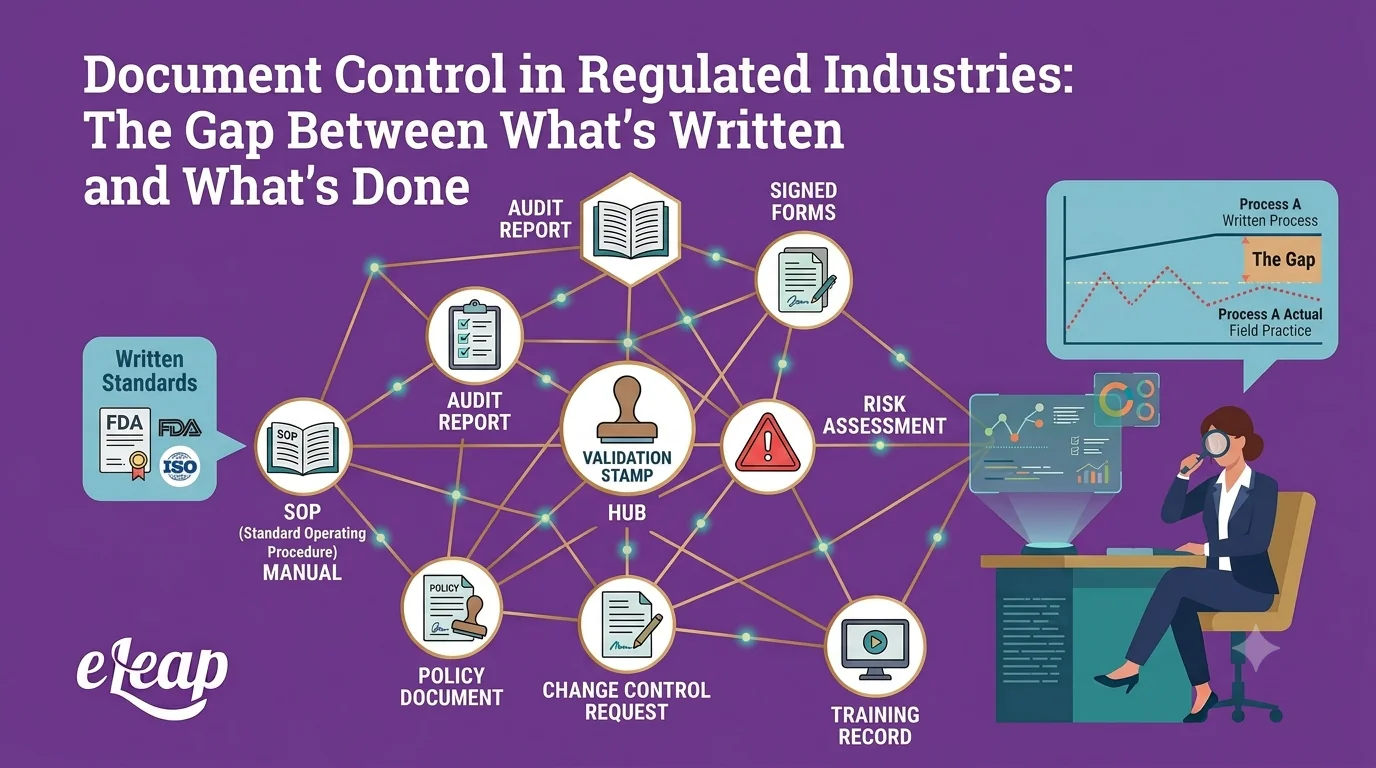
An auditor walks into your facility and asks to see the procedure your production team used to clean the filling line last Tuesday. Your quality manager pulls up a document. It’s version 2.3. The procedure your operator actually followed? Version 2.1, still printed and laminated at the workstation because nobody removed it when the revision went live six weeks ago. The audit finding writes itself.
This scenario plays out across regulated industries with striking regularity — in pharmaceutical batch suites, aerospace assembly floors, food processing plants, medical device cleanrooms, and automotive supplier facilities. The document exists. The approval is on file. The training record shows a checkbox. And the employee followed the wrong version anyway, because the gap between what the quality system says should happen and what actually happens on the floor was never closed.
Document control failures are the most common root cause behind a disproportionate share of audit findings, 483 observations, and quality events across every regulated industry. They’re also among the most preventable. This article examines where document control programs break down, what regulators across every major vertical actually require, and how organizations close the gap between documented procedures and real-world execution.
What Document Control Is — and What It Isn’t
Document management and document control are not the same thing. Document management handles storage and retrieval: where files live, how they’re organized, and who can find them. Document control adds a governance layer on top of that — defining who can create a document, who must approve it before it goes live, when it needs to be reviewed, and how every change gets tracked over time.
In a QMS context, controlled documents include standard operating procedures, work instructions, quality policies, forms, templates, and specifications. These are the documents that drive daily operations. When they’re correct and accessible, processes run consistently. When they’re outdated, unapproved, or inaccessible at the point of use, processes break down — and the consequences in regulated industries range from audit findings to production shutdowns to patient harm.
Every controlled document follows a defined lifecycle: creation, review, approval, distribution, revision, and eventual obsolescence. The document lifecycle must be managed actively at every stage. It’s the breakdown of that management — at specific, predictable stages — that generates the findings regulators cite most frequently.
It’s also worth distinguishing documents from records. Documents provide instructions for performing work — they’re active, revisable, and subject to change control. Records provide evidence that work was performed according to those instructions — they’re completed, unchangeable, and subject to retention requirements. Effective quality systems manage both, but the controls differ. A training record that shows an employee completed training on a document that was already superseded fails on both dimensions simultaneously: the document wasn’t controlled, and the record doesn’t prove what the auditor needs it to prove.
The Regulatory Baseline Across Verticals
Every major regulatory framework applicable to regulated industries imposes explicit document control requirements. The specific language differs, but the underlying expectations are remarkably consistent.
ISO 9001:2015 — The Cross-Industry Foundation
ISO 9001:2015 Clause 7.5 establishes the core requirements for documented information. Organizations must maintain documents in formats and media appropriate for their use, protect them from loss of confidentiality or improper use, control their creation and update, and prevent unintended use of obsolete versions. Clause 7.5.3 specifically requires that documented information be available and suitable for use where and when needed — a deceptively simple requirement that organizations fail regularly by not controlling distribution after revision.
ISO 9001 doesn’t prescribe how document control must be implemented, but it defines what the system must achieve. Organizations determine the extent of their documented information based on size, complexity, and risk profile. A risk-based approach to documentation means that processes with higher failure impact require more detailed, documented controls — and those documents require correspondingly rigorous control.
Pharmaceutical and Biotech — GMP Documentation Standards
FDA 21 CFR Parts 210 and 211 set documentation requirements for pharmaceutical manufacturing that are among the most prescriptive in any regulated industry. Every procedure, every batch record, every deviation and investigation, and every change must be documented in a way that supports full traceability. GMP documentation requirements include numbered SOPs with version control, review and approval processes, defined retention periods, and controlled distribution — plus the ability to demonstrate that every employee performing a regulated task was trained on the current version of the relevant procedure.
The FDA’s emphasis on data integrity amplifies document control requirements significantly. Electronic records must meet 21 CFR Part 11 requirements for audit trails, electronic signatures, and access control. Paper records must be legible, permanent, and attributable. An organization that maintains technically correct procedures but can’t demonstrate that employees followed them — or can’t trace which version was in effect when a deviation occurred — faces the same regulatory exposure as an organization with no procedures at all.
Medical Devices — ISO 13485 and QMSR
ISO 13485:2016 imposes stricter document control requirements than ISO 9001, reflecting the patient safety implications of medical device quality. The standard requires documented procedures for document control itself — not just document control practices, but a written, approved procedure governing how documents are managed. Device history records, design history files, and quality system records all require specific retention periods and access controls. Under the QMSR (FDA’s Quality Management System Regulation, which replaced the former QSR effective February 2026), ISO 13485 is incorporated by reference, making these requirements directly applicable to U.S. device manufacturers. Training documentation gaps related to document version currency are among the most commonly cited FDA 483 observations under the QMSR — specifically, the inability to demonstrate that employees were trained on the version of a procedure that was in effect when a quality event occurred.
Aerospace — AS9100 Rev D
AS9100 Rev D document control requirements extend to external documents (customer specifications, regulatory standards, supplier documentation) as well as internal procedures. Organizations must identify externally originating documents and control their distribution. Configuration management — maintaining accurate and complete documentation of product design and changes — is a core AS9100 requirement that demands document control discipline across engineering, quality, and manufacturing functions simultaneously.
Automotive — IATF 16949
IATF 16949 builds on ISO 9001 document control requirements and adds customer-specific requirements that flow down from automotive OEMs. Control plans, FMEAs, production part approval process (PPAP) documentation, and measurement system analysis records all require version control and traceability. Customer-specific requirements can mandate how specific document types are formatted, retained, and shared — creating a complex multi-stakeholder document control environment for Tier 1 and Tier 2 automotive suppliers.
Food and Beverage — FSMA and GFSI
FSMA requires hazard analysis and food safety plan documentation with defined review frequencies. GFSI-recognized standards, including SQF and BRCGS, impose specific document control requirements as part of food safety management system certification. BRCGS, for example, requires that all documents and data be maintained, controlled, and available, with a clear system for document management including authorization, review, and withdrawal of obsolete documents. Traceability records connecting raw material lots to finished product shipments must be maintained and retrievable within defined timeframes — a requirement that places document control at the center of recall readiness.
Cannabis and Hemp
State cannabis regulations consistently require SOPs for production, testing, and quality activities, with requirements for version control and access that vary by jurisdiction. As federal oversight activity increases, cannabis manufacturers whose document control practices meet pharmaceutical or food safety standards will be demonstrably better positioned than those operating informally. Batch records that link procedures, lot numbers, test results, and personnel signatures are the baseline expectation across virtually every state regulatory program currently in effect.
Where Document Control Programs Actually Fail
Most document control failures don’t originate in the document itself. They originate in the handoffs — the moments between document approval and actual use where the system should enforce compliance but instead relies on human memory, manual processes, or informal communication. The most common failure patterns appear consistently across industries and organization sizes.
Version Scatter
In organizations without centralized document control, every employee maintains their own file copies. When a procedure updates, distribution depends on someone remembering to notify everyone affected. Teams operate on different versions without realizing it. Printed copies accumulate at workstations, in binders, and on shared drives. Filenames like “SOP_final_v3_ACTUAL_revised” replace version numbers. During an audit, demonstrating that the right version reached the right people — and that obsolete copies were withdrawn — becomes impossible.
Version scatter is especially dangerous in multi-site operations. A revision approved and distributed at the main facility may take weeks to reach satellite locations if distribution relies on email and manual processes. During that window, two sites operate against different procedure versions — creating process variability and an audit trail that’s difficult to reconcile.
The Approval Bottleneck
Manual approval workflows — email chains, physical signature routes, shared calendar coordination — consistently create delays that affect operational timelines. A document that needs two reviewers and one final approver can sit in an email inbox for two weeks. Quality system documentation that can’t reach effective status quickly enough forces operations to work without current procedures or to implement changes before they’re formally approved — both of which create compliance exposure.
Approval delays also create version management problems. A document in revision sits in an undefined state while operations continue. If a quality event occurs during an extended approval cycle, investigators want to know which version governed the process — and the answer may be genuinely ambiguous.
Training Never Catches Up
The most cited document control failure in regulated industry inspections isn’t missing documents. It’s the gap between document approval and verified employee training. A document can be correctly approved, properly version-controlled, and accurately distributed — and still generate a 483 observation if training records can’t demonstrate that the employees who performed the associated task were trained on the current version before performing it. SOP training management that depends on manual notification — a training administrator noticing that a document changed and manually enrolling affected employees — produces this gap predictably under operational workload.
The problem compounds when training records don’t capture the document version that was trained. A training record showing that an employee completed “SOP-042 Training” in March doesn’t answer the auditor’s question if SOP-042 has been revised four times since March. Version-specific training records are the only defensible answer — and manual training management systems rarely capture this level of detail consistently.
Overdocumentation and Document Sprawl
The opposite of inadequate documentation is its own problem. Organizations that write procedures for every conceivable scenario produce documentation systems too complex to navigate reliably. Documents multiply, overlap, and contradict each other. Employees stop consulting them because finding the right document takes too long — and informal workarounds fill the gap. Overdocumentation typically produces under-compliance because the procedures employees actually follow diverge from the procedures on file.
SOPs That No Longer Reflect Practice
Documentation that no longer matches actual workflows creates the most dangerous document control gap: a written procedure that employees knowingly don’t follow because it’s outdated, impractical, or simply wrong. When this happens, the organization has documented evidence of non-compliance built into its quality system. Every record signed against that procedure is signed against something that doesn’t describe what was actually done. Correcting this requires not just document revision but often a deviation investigation, a CAPA, and potentially a regulatory disclosure.
The Document-Training Connection: Why Separation Is the Root Cause
The single most consistent finding across regulated industry document control failures is structural: document control and training management operate as separate systems, connected — if at all — by manual handoffs. When a document is approved in the QMS, someone has to notice that the approval happened, determine who needs to be retrained, enroll them in the training, track completion, and update the training record with the new document version. Each of those steps is a point of failure when done manually.
The consequences are specific and predictable. An employee trained on version 2.1 of a procedure when version 2.2 has already been approved is a compliance liability — and in a disconnected system, that scenario can persist for weeks or months without anyone realizing it. An auditor reviewing a nonconformance will ask whether the employee was trained on the version in effect when the event occurred. In a disconnected system, answering that question requires correlating training records, document revision history, and event timestamps manually across systems that weren’t designed to talk to each other.
The architecture that eliminates this gap connects document control and training as a single workflow. When a document is approved, training assignments deploy automatically to every employee whose role requires training on that document. The training record captures the specific document version. Completion is tracked and reported in real time. The integrated QMS+LMS approach treats document approval and training deployment as one process rather than two adjacent functions that someone has to manually connect.
Document Control Requirements by Document Type
Not all controlled documents require the same level of rigor. A risk-based approach to document control concentrates oversight on documents that directly govern product quality, patient safety, or regulatory compliance — while applying lighter controls to reference materials and supporting documentation.
Standard Operating Procedures
SOPs governing manufacturing processes, quality testing, cleaning and sanitation, calibration, and deviation handling require the most rigorous control — version numbering, formal approval workflows, controlled distribution, withdrawal of obsolete copies, and version-specific training records for every employee who performs the associated task. Review cycles should be defined and tracked; annual review is a common baseline, with more frequent review required for procedures governing high-risk or frequently changing processes.
Work Instructions
Work instructions provide task-level detail that supports SOP execution. They carry the same control requirements as SOPs in regulated environments — employees performing quality-critical tasks must follow current, approved work instructions, and training records must demonstrate version-specific competency. Changes to manufacturing processes frequently require simultaneous revision of both the governing SOP and the associated work instructions.
Forms and Templates
Blank forms used to create quality records require version control because a completed record is only as reliable as the form on which it was created. Using a superseded form to capture a batch record, inspection result, or CAPA investigation creates a traceability problem — the data captured may be structurally inconsistent with current requirements. Form version control is frequently overlooked in document control programs and frequently cited in audits.
External Documents
Regulatory standards, customer specifications, pharmacopoeial methods, and supplier certifications all originate outside the organization but govern internal activities. ISO 9001:2015 Clause 7.5 requires that externally originated documents be identified and managed within the QMS document control system. Organizations that manage external standards informally — relying on whoever holds the current copy to notice when an update is issued — create compliance gaps that may not surface until an audit reveals a process governed by a superseded external standard.
Change Control: Where Document Control and Quality Events Meet
Document revisions don’t happen in isolation. In regulated industries, changes to procedures typically originate from quality events: a CAPA that identified a process gap, a deviation that revealed an inadequate procedure, a supplier change that requires updating a specification. Change control management is the system that governs how those changes move from identification through impact assessment, approval, implementation, and effectiveness verification.
The connection between change control and document control is where many quality systems develop structural gaps. When change control software and document management operate separately, the link between a change record and the document revision it triggered exists only in someone’s memory or a manually maintained cross-reference. Auditors who ask why a procedure changed should be able to follow the complete chain: the quality event that identified the need, the change control record that governed the assessment and approval, the document revision that implemented the change, and the training records proving affected personnel were competent on the new version before going live.
Organizations that can walk an auditor through that complete chain — in one system, in minutes — demonstrate a materially different level of quality system maturity than those who have to reconstruct it from emails, spreadsheets, and physical signatures. That difference shows up in audit outcomes.
Building Document Control That Holds
The technical requirements of effective document control aren’t complex. The document management system needs to enforce version control automatically, route approvals without manual chasing, distribute to the right people when documents go live, archive obsolete versions in read-only states, and generate an audit trail that’s tamper-evident and complete. What makes document control hard isn’t the technology — it’s the organizational discipline to use it consistently and the system design that makes compliance the path of least resistance.
Several design principles separate document control programs that hold up under audit from those that generate findings consistently. First, controlled documents should have a single authoritative source that everyone in the organization uses — not a master copy plus however many local copies individuals have accumulated. If it’s not in the system, it doesn’t exist. Second, approval workflows should be automated, not email-based, with defined turnaround expectations and escalation paths that prevent bottlenecks.
Third, and most critically, document approval and training assignment must be connected at the system level. The moment a document reaches approved status, the system should generate training assignments for every affected role and begin tracking completion before the effective date. Fourth, access controls should prevent employees from viewing or printing superseded versions — not rely on someone remembering to remove them.
For organizations evaluating whether their current document control approach meets these standards, eLeaP’s Document Management System manages the complete document lifecycle from creation through obsolescence — with automated version control, compliant electronic signatures, QMS-integrated training triggers, and audit trails that connect document revisions to the quality events that produced them. The platform meets FDA 21 CFR Parts 11, 211, and 820 requirements, ISO 9001 and 13485 requirements, AS9100, IATF 16949, and GxP standards across life sciences and manufacturing.
Conclusion
The gap between what’s written and what’s done in regulated organizations is almost always a document control problem in one of its many forms: the wrong version at the workstation, the approval stuck in someone’s inbox, the training that never caught up with the revision, or the procedure that no longer matches actual practice. Each of these failures is preventable — and each one costs more to correct after an audit finding than it would have cost to prevent with a functioning document control system.
The regulatory frameworks governing every industry eLeaP serves — pharma, biotech, medical devices, aerospace, automotive, food and beverage, cannabis, and manufacturing — all reach the same conclusion: you cannot manage quality without managing documentation. And you cannot manage documentation without the systems, workflows, and integrations that make compliance the automatic outcome of normal operations rather than an effort layered on top of them.
Organizations that invest in structured document control integrated with their training management and change control systems don’t just avoid audit findings — they build the operational foundation that makes every other quality system element more effective. Document control isn’t the most glamorous function in a quality system. It’s the one that holds everything else together.