CAPA for CROs: How to Fix Root Causes Before the FDA Finds Them

A CAPA process at a contract research organization holds up under inspection when it fixes the systemic condition behind a deviation. FDA investigators and sponsor auditors don’t ask whether a protocol deviation occurred — every active study has them. They ask whether the corrective action addressed why the deviation was possible in the first place, and whether the record proves it. This guide walks through where CRO CAPA systems typically break down, what a complete record actually requires under ICH E6(R3) and ICH Q10, and where the training verification gap costs most organizations their next audit finding.
Key takeaways
- CAPA effectiveness fails most often when root cause analysis stops at the proximate cause instead of the systemic condition behind it.
- ICH Q10 Section 3.2.2 requires five documented stages: problem identification, root cause analysis, corrective action with an owner and due date, implementation verification, and an effectiveness check.
- FMEA is a preventive risk-assessment tool, used before a failure occurs — not a root cause analysis method for one that has already happened.
- CRO CAPA architecture has to isolate each sponsor’s records from other sponsors’ while still surfacing systemic root causes across all sponsors and sites.
- The most common documentation gap is a corrective action that assigns training without verifying it was completed, understood, or effective.
What CAPA Means Under ICH E6(R3) for CROs
Under ICH E6(R3) Good Clinical Practice, Section 3.9.3 defines an important deviation as a departure that may significantly affect a participant’s rights, safety, or well-being, or that may significantly impact the completeness, accuracy, or reliability of trial data. The guideline places responsibility for the underlying criteria on the sponsor, who defines what counts as important on a trial-by-trial basis. Important deviations require prompt reporting, including notification to the IRB or ethics committee where subject safety or trial integrity is affected.
Below that formal threshold, most CRO quality systems layer their own SOP-defined minor and major tiers on top of the ICH E6(R3) important-deviation requirement. That tiering is a widely used industry convention, not a classification scheme the guideline itself names, and it typically scopes reporting timelines and sponsor notification for deviations that don’t rise to important. Those lower-tier deviations still require documentation and trending, even when no individual notification is triggered.
Classification determines how quickly a deviation has to be reported and to whom. Whether the underlying problem actually gets fixed is a separate question, answered by the CAPA that follows.
Responsibility for CAPA in a clinical trial is shared, not concentrated in one place. Under ICH E6(R3), the sponsor holds ultimate responsibility for trial oversight, but a CRO performing delegated quality functions is responsible for identifying, investigating, and correcting the deviations and quality events within the scope of its contracted responsibilities, as defined in the transfer-of-obligations agreement. A CRO’s CAPA system has to produce records that satisfy both its own quality unit and the sponsor’s oversight expectations, since the sponsor remains accountable to regulators even when day-to-day CAPA execution sits with the CRO.
CAPA, Deviation, and Nonconformance: How the Terms Relate
The terms deviation, nonconformance, and CAPA describe different parts of the same process, and CRO quality teams often use them inconsistently. A deviation is the event: a departure from the protocol, an SOP, or another specified requirement. Nonconformance is more commonly used in a GMP or manufacturing quality system to describe a comparable departure from a specification, though many quality platforms use the two terms interchangeably in a clinical context. CAPA is the process an organization runs in response to a quality event, whether that event gets logged as a deviation, a nonconformance, an audit finding, or a trend crossing a threshold. A CRO evaluating its own terminology should be able to trace, for any given quality event, exactly which CAPA record addressed it, rather than treating the naming convention as a cosmetic detail with no bearing on traceability.
The Proximate-Cause Trap
Most CRO CAPA systems fail in the same place: the investigation stops at the proximate cause instead of the systemic one. A site coordinator misses a visit window. An investigational product sits outside its storage temperature range for a few hours. A consent form gets signed after enrollment procedures have already started. The corrective action addresses that specific event — retrain the coordinator, recalibrate the storage unit — and the effectiveness check finds no immediate recurrence. The CAPA closes.
Then, months later, a different coordinator at a different site makes the same mistake. The real root cause sat in the control system that allowed the error to happen in the first place: an ambiguous protocol section, a training program that covered the requirement once at study start-up and never again, a monitoring visit schedule that couldn’t catch the gap before it recurred.
A root cause statement of “coordinator error,” with no analysis of why the error was possible or what allowed it to go undetected, does not hold up under inspection. What an investigator is actually asking is what would prevent this from happening again, anywhere in the program — at any site, with any coordinator, on any study running the same protocol language or the same training design.
Structured Root Cause Analysis — and Where FMEA Actually Belongs
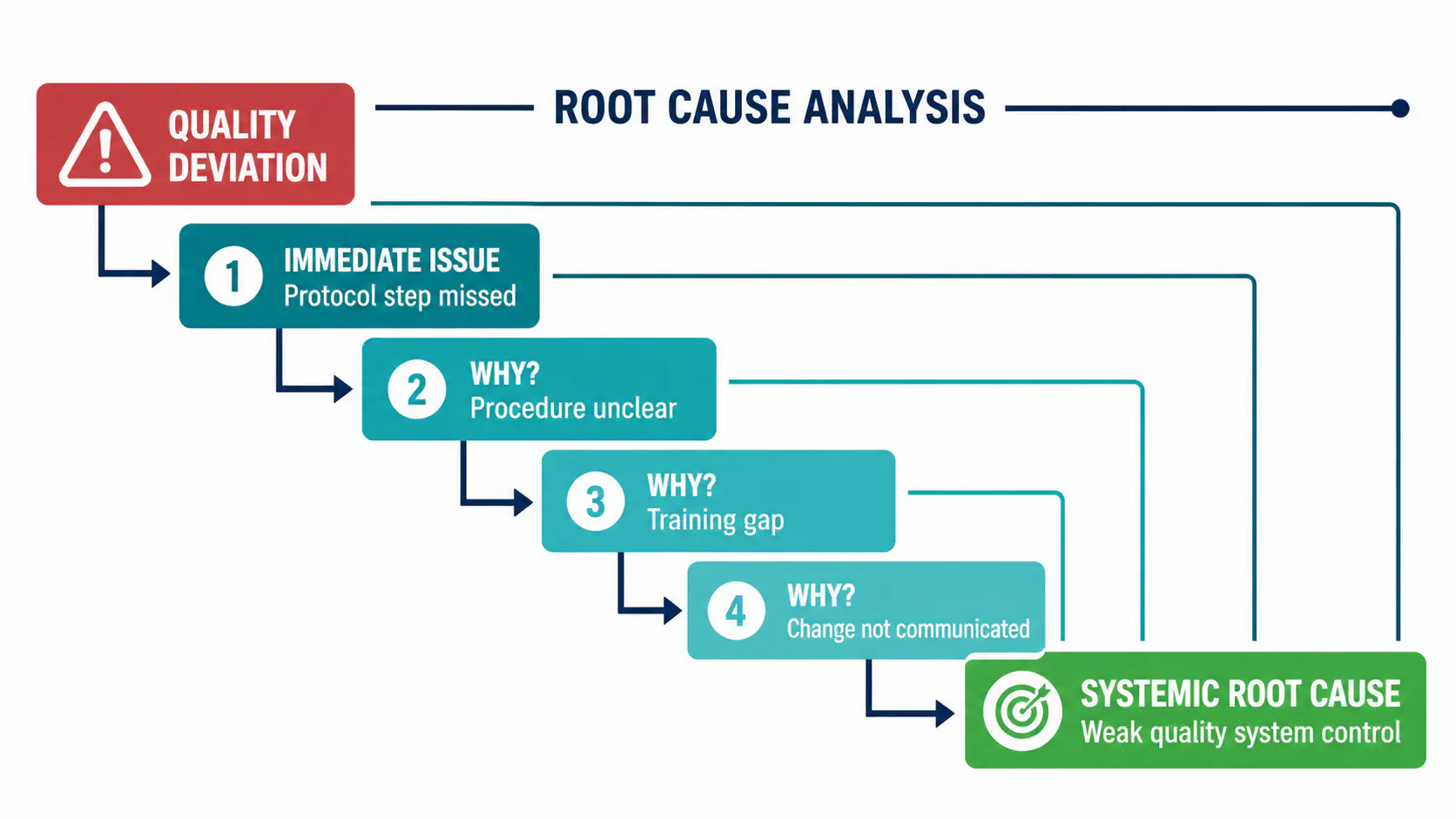
Structured methods exist specifically to push an investigation past the first, easiest answer. A five-whys walkthrough asks why the deviation occurred, then asks why that answer was true, repeating until the chain reaches a condition the organization actually controls — a procedure, a training design, a monitoring frequency — rather than stopping at an individual’s action. A fishbone diagram maps the same investigation across categories: people, process, equipment, and materials, surfacing contributing factors an investigation focused on a single individual would miss entirely.
Applied to the missed visit window described earlier, a five-whys walkthrough might run like this: Why was the visit missed? The coordinator didn’t see the scheduling alert. Why didn’t they see it? The alert appeared in a system the coordinator doesn’t check daily. Why does the alert live in that system? The study’s monitoring plan assigned visit-window tracking to a system that didn’t match the site’s actual daily workflow. Why was that assignment made? No one on the study start-up team confirmed the tracking system matched how the site actually operates before the study went live. Four questions in, the root cause has moved from an individual’s missed notification to a start-up process that never verified tool-to-workflow fit — the condition a corrective action actually needs to address.
It’s worth being precise about where an FMEA fits into this picture, since it’s a frequent point of confusion in CRO quality systems. An FMEA is a preventive tool, used to score the probability and severity of potential failure modes before they occur. Running a process FMEA on a new protocol’s site-activation workflow, before enrollment starts, is a legitimate and valuable use of the tool — it identifies where a protocol’s design, a training plan, or a monitoring schedule is likely to produce deviations, and lets the organization address that risk before the first subject is enrolled. Applying an FMEA to explain a deviation that has already occurred is a misapplication, and inspectors notice it. The tool answers what could go wrong, ahead of time — a different question than what did go wrong, and why, after the fact.
The Five-Stage CAPA Record ICH Q10 Requires
ICH Q10 identifies CAPA as one of four elements of the pharmaceutical quality system, and Section 3.2.2 defines what a complete record requires. Each of the five stages below has to be documented in its own right:
| Stage | What It Requires |
|---|---|
| 1. Problem identification | The deviation, complaint, audit finding, or trend that triggered the CAPA, described specifically enough that a reviewer unfamiliar with the study can understand what happened. |
| 2. Root cause analysis | The systemic condition behind the event, reached through a structured method rather than an assumption, with the analysis itself documented alongside its conclusion. |
| 3. Corrective action | A specific action, assigned to a named individual with the authority to implement it, with an owner and a due date. |
| 4. Implementation verification | Confirmation that the corrective action described actually happened, on the date it was supposed to happen, with evidence attached. |
| 5. Effectiveness check | A review of real data after the action has had time to work, at a defined interval after closure, confirming the deviation rate or failure pattern actually changed. |
A record missing any one of those five stages is incomplete before an inspector ever opens the file. In practice, stage four and stage five are where most CRO CAPA records fall short: a corrective action gets described and assigned, but the confirmation that it happened, and the follow-up check that it worked, rarely make it into the record with the same rigor as the investigation itself.
Preventive Action: The Half Most CRO Quality Systems Skip
CAPA stands for corrective and preventive action, but most quality teams only build muscle for the corrective half. The preventive half is supposed to catch a failure before it happens, using trending data most CROs already collect but rarely act on until a threshold is crossed. A site’s protocol deviation rate climbing across three consecutive monitoring visits, a CRA’s query response time slipping quarter over quarter, an audit finding category recurring across multiple sites, or a vendor’s data query rate trending upward are all preventive CAPA candidates, even though nothing has technically gone wrong yet in any single instance.
An organization that only opens a CAPA after an actual deviation is running half the system. An auditor who asks for a preventive action trending log will notice the gap immediately if all that exists is a folder of after-the-fact corrections filed under the corrective side. Building the preventive habit typically means setting a regular cadence, monthly or per monitoring cycle, for reviewing the same trending metrics an effectiveness check would look at anyway, and treating a metric crossing a defined threshold as a CAPA trigger in its own right. A quality unit that reviews deviation rates by site, by protocol, and by personnel role on that cadence will typically catch a developing pattern several monitoring visits before it produces a deviation serious enough to trigger a corrective CAPA on its own — at which point the preventive action has already done its job.
CAPA Effectiveness Verification: What Auditors Actually Check
Effectiveness verification is supposed to answer a specific question at a specific point in time: did the corrective action actually change the pattern that triggered the CAPA. That means comparing real post-closure data — the deviation rate for the affected process at thirty, sixty, or ninety days — against the baseline that existed before the corrective action was implemented. A sponsor auditor reviewing a closed CAPA will typically ask for exactly that comparison, and a record that shows only that the corrective action was assigned answers a different question than the one being asked.
The interval matters as much as the comparison. An effectiveness check run immediately after the corrective action is implemented mostly confirms the action happened rather than that it worked — recurrence often takes a full study cycle or several monitoring visits to show up. Setting the effectiveness check interval based on how frequently the underlying process actually generates data, rather than defaulting to a fixed thirty-day window regardless of context, produces a check that means something. A monitoring visit cadence that occurs every six to eight weeks, for example, needs an effectiveness window long enough to capture at least one full cycle of that data, or the check ends up measuring only the absence of an immediate complaint.
Multi-Sponsor CAPA Architecture: The CRO-Specific Complexity
CROs carry a layer of complexity a single-sponsor quality system doesn’t have to manage. A CAPA opened in response to Sponsor A’s audit finding has to stay isolated from Sponsor B’s study records, even when both studies run through the same site and the same personnel. Sponsor A’s quality team needs visibility into their own CAPA status and should never see Sponsor B’s. At the same time, the CRO’s own quality organization needs visibility across every sponsor and every site, because a root cause that’s systemic to the organization’s operations won’t announce itself as systemic if every CAPA record lives sealed inside its own sponsor-scoped silo.
Consider a site coordinator working three concurrent studies for three different sponsors. A protocol deviation on Sponsor A’s study gets investigated, and the root cause turns out to be a general gap in how the site’s onboarding training covers visit-window calculation, unrelated to Sponsor A’s protocol specifically. If that CAPA record can’t be viewed in the context of the coordinator’s full training history across all three sponsors, the same gap keeps producing deviations on Sponsor B’s and Sponsor C’s studies, each one investigated as an isolated event, each one consuming a full investigation cycle to arrive at a root cause the CRO’s quality organization already had evidence of.
This is also where sponsor audit response becomes operationally difficult without the right architecture. A quality agreement typically requires the CRO to produce, on request, every CAPA record relevant to that sponsor’s studies, along with response and closure status. Producing that package by hand, from records scattered across separate sponsor-specific folders or systems, is where audit-response timelines slip.
The Training Verification Gap: Where Most CAPAs Actually Fail
The single most common CAPA failure point is a corrective action that reads “additional training provided,” with nothing behind it: no record of who was trained, on which version of the procedure, or whether they demonstrated understanding before returning to study activities. A real effectiveness check confirms that training happened and that competency was demonstrated, using the same rigor described above: real data, at a defined interval, compared against a baseline.
A CAPA that closes on the date training was assigned, before completion and effectiveness are confirmed, is a postponed problem wearing a closed-status label. This is exactly the gap eLeaP’s training-gate mechanism is built to close: a CAPA record can’t move to closed status until the personnel named in the corrective action have completed and passed training tied to the specific procedure version that prompted the CAPA. The sequence — investigation, corrective action, training completion, effectiveness verification — is enforced by the system rather than left to a quality associate’s memory. Get a demo of eLeaP to see how this works.
Common CAPA Documentation Mistakes CROs Make
- Root cause listed as an individual’s action (“coordinator error,” “analyst mistake”) rather than the system that allowed the action to occur.
- FMEA used to justify a root cause finding after a failure, rather than as a preventive tool applied before one.
- Corrective action recorded as “additional training provided,” with no record of who, which procedure version, or demonstrated competency.
- Effectiveness check run immediately after implementation, before enough time has passed for recurrence to show up in the data.
- CAPA records for one sponsor visible to, or confused with, another sponsor’s program.
- Preventive action treated as optional, with CAPAs opened only after an actual deviation rather than from trending data.
- Implementation verification and effectiveness verification treated as the same step, when they answer two different questions.
Building a CAPA Process That Holds Up to Inspection
A CAPA record that holds up to inspection follows the same closed loop every time: a finding, root cause analysis that reaches the systemic condition rather than the proximate one, a corrective action with an owner and a due date, verified training completion where training is part of the action, and a documented effectiveness check against real post-closure data. Fixing the root cause before a sponsor or the FDA finds it first is what separates a CAPA system that produces paperwork from one that produces evidence the quality system actually works.
FAQ
What is CAPA in a CRO?
CAPA (corrective and preventive action) in a CRO is the quality process that investigates the root cause of a protocol deviation or other quality event, implements a corrective action to fix it, verifies the action was completed and effective, and, on the preventive side, addresses trending risks before a deviation occurs. Under ICH E6(R3), deviations that meet the guideline’s important-deviation threshold trigger formal reporting obligations; most organizations layer their own SOP-defined minor and major tiers on top of that for everything below it.
What’s the difference between corrective and preventive action?
Corrective action responds to a deviation or nonconformance that has already occurred. Preventive action addresses a risk identified through trending or risk assessment before any failure has happened — for example, opening a CAPA because a site’s deviation rate is climbing, rather than waiting for an actual deviation.
Why do CAPAs fail during FDA inspections?
The most common reasons are root cause analysis that stops at the proximate cause instead of the systemic one, and effectiveness checks that don’t confirm the corrective action, most often training, was actually completed and verified rather than simply assigned.
Is FMEA a root cause analysis tool?
No. FMEA (Failure Mode and Effects Analysis) is a preventive tool used to score the probability and severity of potential failure modes before they occur. It is a method for assessing risk ahead of a failure, useful for evaluating a new protocol or process before enrollment starts, rather than for analyzing the root cause of a failure that has already happened.
How long should a CAPA effectiveness check run before closure?
The interval should match how frequently the underlying process generates data — a fixed thirty-day window applied regardless of context often closes before recurrence would have had a chance to show up. Basing the interval on the process’s actual data frequency, and extending it for lower-frequency events, produces an effectiveness check that means something.
How does CAPA work across multiple sponsors at a CRO?
A CRO’s CAPA system isolates each sponsor’s CAPA records from other sponsors’: Sponsor A cannot see Sponsor B’s findings or corrective actions. At the same time, the CRO’s own quality organization needs visibility across all sponsors and sites, to catch systemic root causes that would otherwise stay hidden inside separate, sponsor-scoped silos.
What documentation does an FDA investigator expect for CAPA training verification?
An investigator typically expects a record showing which personnel were assigned training as part of a corrective action, which procedure version that training was tied to, the date training was completed, and evidence of a competency check confirming the training actually took hold.
Does risk-based monitoring change how CAPA works in a CRO?
Risk-based monitoring shifts more site-oversight data into centralized trending analysis, which means CAPA triggers increasingly come from monitoring signals such as data query patterns or site performance metrics, in addition to findings identified during on-site visits. That makes the preventive half of CAPA more central than it was under a purely on-site monitoring model.
Is a CAPA required for every protocol deviation?
Every protocol deviation should be documented and assessed, but not every deviation typically warrants a full CAPA investigation. Whether a deviation meets the ICH E6(R3) important-deviation threshold, plus how an organization’s own SOPs further tier deviations below that line, generally determines which ones require a full root cause investigation and corrective action, versus documentation and trending alone.