ISO 9001 vs. ISO 13485: Differences, Key Requirements, and the Compliance Gap Most QMS Guides Miss

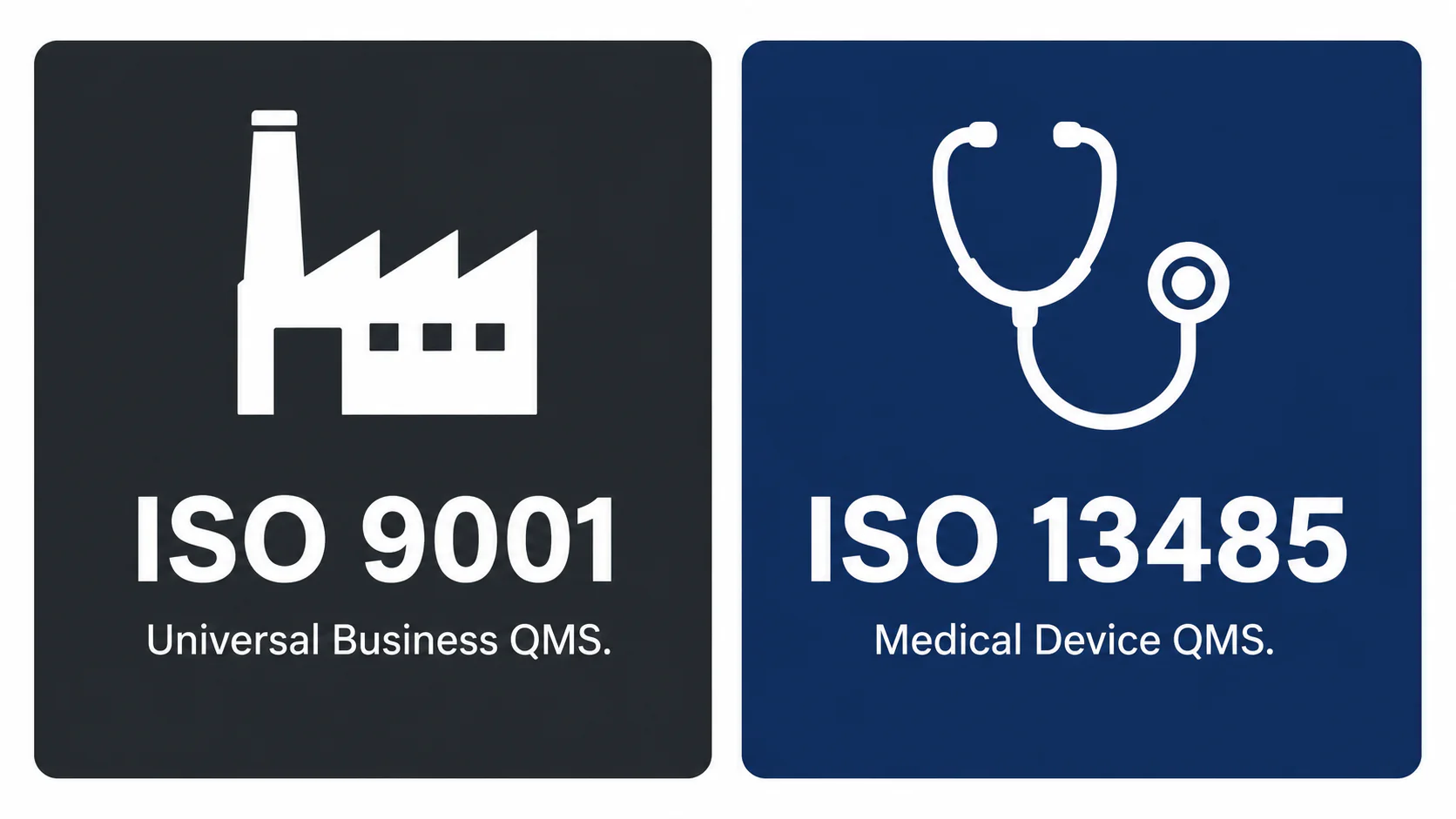
If you manage quality or regulatory compliance in a highly regulated environment, you have likely run into this common piece of advice: “ISO 9001 and ISO 13485 are essentially the same quality management standard—they just cover different industries and require slightly different paperwork.”
This assumption is one of the most dangerous myths in modern quality management.
Treating these two standards as interchangeable has directly led organizations into severe audit findings, failed regulatory inspections, delayed market approvals, and—in the worst-case scenarios—defective products pulled from the market.
While they do share a common ancestry, they are fundamentally different frameworks designed to achieve entirely different objectives. In this comprehensive guide, we will dissect the specific differences between ISO 9001 and ISO 13485, break down what the upcoming ISO 9001:2026 revision means for your organization, analyze how the FDA’s Quality Management System Regulation (QMSR) impacts medical device players, and expose the single compliance gap that most implementation guides completely ignore.
1. Quick Answer: What is the Difference Between ISO 9001 and ISO 13485?
If you are looking for a quick, direct answer for your compliance roadmap, here is the core distinction:
ISO 9001 is an industry-agnostic standard designed to help businesses consistently deliver high-quality products and services while continuously improving customer satisfaction and internal business processes.
ISO 13485 is a highly prescriptive, industry-specific standard designed for the medical device lifecycle. It prioritizes patient safety, clinical efficacy, and regulatory compliance over customer satisfaction and business performance.
A critical structural detail most quality professionals overlook is that ISO 13485 is based on ISO 9001:2008, not the newer ISO 9001:2015 or ISO 9001:2026 versions. This is a deliberate, strategic decision by the International Organization for Standardization (ISO). The medical device sector purposefully chose to bypass the “customer satisfaction” and “organizational opportunity” drivers of the newer ISO 9001 structures, choosing instead to double down on raw safety, product consistency, and strict regulatory alignment.
2. Deep Dive: Understanding ISO 9001
ISO 9001 is the world’s most widely adopted quality management system (QMS) standard, boasting more than 1.3 million certificates held globally, according to ISO Survey data. It is utilized across a vast array of sectors, including software engineering, construction, food manufacturing, aerospace, and general services. It even operates alongside mandatory Good Manufacturing Practices (GMP) within pharmaceutical supply chains.
The underlying philosophy of ISO 9001 is straightforward: establish a systematic, process-oriented framework that consistently meets customer needs while satisfying any applicable statutory and regulatory requirements.
The Seven Quality Management Principles of ISO 9001
The entire ISO 9001 framework is structured around seven foundational principles:
- Customer Focus: Aligning organizational processes with customer expectations to boost customer retention and satisfaction.
- Leadership: Establishing unity of purpose, direction, and engagement through proactive management.
- Engagement of People: Empowering and respecting employees at all levels to foster continuous improvement.
- Process Approach: Managing activities as interrelated processes that function as a cohesive system.
- Improvement: Maintaining an ongoing focus on enhancing processes, products, and overall business performance.
- Evidence-Based Decision-Making: Relying on the analysis and evaluation of data to make informed business decisions.
- Relationship Management: Actively managing relations with external providers, partners, and stakeholders to optimize performance.
The ISO 9001:2026 Revision: What Is Changing?
ISO 9001 is currently transitioning. The much-anticipated ISO 9001:2026 revision is in its final draft stages and is slated for official publication in September 2026. Once published, organizations will have a standard three-year transition window—giving companies until approximately September 2029 to align their systems and transition their certifications.
The 2026 revision does not represent a radical overhaul of the standard’s core philosophy; rather, it introduces targeted refinements designed to modernize the framework for modern business landscapes.
If your organization is currently certified under ISO 9001:2015, you must plan for several key shifts:
- Integration of Climate-Related Factors (Clause 4.1 & 4.2): First introduced via a joint ISO amendment in February 2024, the 2026 revision formally bakes climate considerations into the foundation of the standard. Organizations must explicitly determine whether climate-related issues represent a relevant risk to their organizational context and the objectives of their QMS.
- Quality Culture and Ethical Behavior (Clause 5.1 & 7.3): Leadership is no longer allowed to treat quality culture as an unspoken byproduct of processes. Top management is now explicitly required to promote, support, and demonstrate a culture of quality and ethical conduct. Furthermore, employees must be formally aware of how their work aligns with these ethical guidelines.
- Distinct Separation of Risk and Opportunity (Clause 6.1): In the 2015 version, risks and opportunities were often lumped together as “risk-based thinking.” The 2026 standard separates them into distinct clauses, requiring organizations to apply unique procedures, methodologies, and documented evaluations for both risks (minimizing threats) and opportunities (capitalizing on business advantages).
- Expanded Work Environments (Clause 7.1.4): To reflect modern work structures, the standard now explicitly addresses psychological safety, cultural factors, and remote or hybrid infrastructure when managing the “environment for the operation of processes.”
- Rigorous Change Management (Clause 6.3): Organizations must now follow highly structured practices for managing operational changes, which includes documenting the communication of changes, reviewing change outcomes, and evaluating the overall effectiveness of those changes.
3. Deep Dive: Understanding ISO 13485
First published in 1996 and last updated in 2016, ISO 13485 is the global baseline quality management standard for organizations involved in the medical device lifecycle. This includes companies handling device design, clinical testing, commercial manufacturing, storage, logistics, installation, servicing, and technical support. It also extends to key upstream services such as calibration, software development, raw material supply, and contract sterilization.
Unlike the flexible, business-focused ISO 9001, ISO 13485 is built to satisfy strict, non-negotiable global regulatory requirements. Because medical devices carry high clinical stakes, the standard prioritizes safety, efficacy, risk mitigation, and structural consistency above all else.
The Global Regulatory Impact of ISO 13485
While ISO 9001 certification is typically a commercial advantage, ISO 13485 compliance is effectively a legal requirement for market access in many jurisdictions:
- The European Union (EU MDR): ISO 13485 certification serves as the primary route for medical device manufacturers to establish conformity and secure a CE mark under the European Medical Device Regulation (MDR) and In Vitro Diagnostic Regulation (IVDR).
- The United States (FDA QMSR Transition): In one of the most historic regulatory shifts in decades, the US FDA officially issued its Quality Management System Regulation (QMSR) final rule. Under this rule, the FDA has amended 21 CFR Part 820 to align directly with ISO 13485:2016. If you sell medical devices in the United States, your QMS is now legally inspected against the core requirements of ISO 13485.
- Global Harmonization (MDSAP): The Medical Device Single Audit Program (MDSAP) allows a single regulatory audit to satisfy the requirements of up to five different global markets (United States, Canada, Brazil, Australia, and Japan). This joint program is heavily built around the requirements of ISO 13485.
4. Side-by-Side Analysis: 5 Critical Differences
To understand why treating these two systems as “identical” is a recipe for disaster, let’s analyze their differences across five core functional dimensions.
| Feature / Dimension | ISO 9001 (Universal Framework) | ISO 13485 (Medical Device Framework) |
| Scope & Applicability | Universal: Applicable to any company in any sector, regardless of product type or size. | Highly Exclusive: Limited to medical devices, clinical components, and related supply chains. |
| Primary Philosophy & Driver | Continuous Improvement & Customer Delight: Focused on making processes more efficient and making customers happier. | Patient Safety & Regulatory Efficacy: Focused on reducing clinical risk and proving the system consistently works. |
| Documentary Architecture | Highly Flexible: Dropped the strict requirement for a formal “Quality Manual” in its 2015 revision. | Strictly Prescriptive: Mandates a Quality Manual, Device Master Records, and highly detailed procedure controls. |
| Risk Management Application | Risk-Based Thinking: Risk is used as a broad planning tool to identify general organizational opportunities. | Formal Risk Assessments: Risk management is strictly tied to ISO 14971 throughout product realization. |
| Training & Competence Proof | Broad Capability: Focuses on general employee competence and taking generic actions to educate teams. | Closed-Loop Effectiveness: Requires documented processes to evaluate and prove the effectiveness of training. |
Detailed Breakdown of Key Differences
A. Scope and Applicability
ISO 9001 is completely industry-agnostic. A commercial bakery, a corporate law firm, and a microchip manufacturer can use the exact same standard to design their QMS.
ISO 13485 is highly exclusive. It applies only to companies that directly interact with medical devices. If you produce the medical-grade plastic tubing used in a ventilator, your quality system must be aligned with ISO 13485. If you produce the standard packaging cardboard box that houses the sterile ventilator, you may operate under ISO 9001, though medical buyers are increasingly demanding that even tier-2 suppliers understand ISO 13485 protocols.
B. Continuous Improvement vs. System Effectiveness
In ISO 9001, the system expects you to prove that you are continuously improving your business. This is typically measured by looking at decreasing customer complaints, rising customer satisfaction scores, and improved yield rates.
In ISO 13485, the concept of “improvement” is handled differently. The primary goal is to maintain the safety and effectiveness of the medical device and the QMS itself. Under ISO 13485, a drop in customer complaints isn’t automatically considered a win unless the company can explicitly prove that patient safety was never compromised in the first place. The standard focuses on the suitability of the system over the growth of the business.
C. Prescriptive Control vs. Administrative Flexibility
Over its last few revisions, ISO 9001 has moved away from rigid documentation requirements in favor of flexibility. For example, the 2015 standard completely removed the long-standing requirement to maintain a formal “Quality Manual,” opting instead for the more modern term “documented information.”
ISO 13485 explicitly kept the requirement for a formal Quality Manual. Furthermore, it demands highly detailed, prescriptive, documented procedures for a wide range of operational steps, including:
- Document control and record management
- Design and development files
- Traceability matrices (part, batch, and supplier traceability)
- Sterilization validation and environmental cleanliness protocols
- Medical device master records (containing complete technical files for every device model)
D. Broad Risk Thinking vs. Rigorous Clinical Risk Management
Under ISO 9001, risk management is treated as “risk-based thinking.” It is applied broad-scale to identify general business pitfalls and strategic opportunities.
Under ISO 13485, risk management is not a general philosophy—it is a strict, document-heavy engineering requirement. The standard mandates that risk management must be active across every phase of product realization (from concept to post-market surveillance). In practice, this requires medical device players to align their risk processes with ISO 14971 (the international standard for the application of risk management to medical devices). This involves running formal Failure Mode and Effects Analyses (FMEAs), Hazard Analyses, and maintaining living risk management files for every SKU.
ISO 13485 references ISO 14971 as guidance rather than a word-for-word mandate, but auditors and notified bodies treat a fully active ISO 14971 program as the accepted way to satisfy Clause 7.1’s risk management requirement. In practice, without one, ISO 13485 certification isn’t attainable.
E. Broad Training vs. Validated Training Effectiveness
Under ISO 9001, an organization must ensure that personnel are competent to perform work that affects quality. This is usually achieved through general training logs and standard qualifications.
Under ISO 13485, employee training is subject to deep regulatory scrutiny and strict audit requirements. The standard mandates that organizations must establish documented processes to verify that any training provided was actually effective.
Simply having an employee sign a sheet of paper to prove they attended a lecture is not enough. You must be able to demonstrate that the employee actually absorbed the material, altered their behavior on the production floor, and can perform the task without introducing clinical risk.
5. The Silent Audit Trap: The QMS-LMS Compliance Gap
Even if your organization maintains highly accurate documentation, utilizes cutting-edge production equipment, and employs highly qualified teams, you may still be sitting on a compliance time bomb.
Both ISO 9001 and ISO 13485 mandate a fully functional quality management system. Both also require your teams to be demonstrably competent. However, neither standard tells you how to connect these two distinct environments—and this lack of integration is exactly where major audit findings and FDA warning letters originate.
Let’s walk through a common, real-world compliance scenario to illustrate how this gap opens:
| Quality Event Identified in QMS |
| ▼ |
| CAPA Opened: Root Cause Found Root cause: SOP version out of date / operator untrained |
| ▼ |
| SOP Updated in QMS |
| ▼ |
| ⚠ THE GAP — MANUAL RE-ENTRY Information manually pushed to a separate training tracker |
| ▼ |
| Retraining Completed in LMS |
| ▼ |
| CAPA Manually Closed in QMS |
| ▼ |
| ❌ Audit Finding No automated trace from event to training record |
The Scenario
- During a routine quality control check, an inspector catches a critical batch record error.
- Your QMS team opens a Corrective and Preventive Action (CAPA) investigation to identify the root cause.
- The investigation uncovers the root cause: an operator was running an outdated version of a Standard Operating Procedure (SOP) because they weren’t properly trained on the latest procedure revision.
- Your quality team immediately updates the SOP to the correct revision, schedules a retraining session for the operator, and records the completion of the training. The CAPA is marked as resolved and closed.
- Six months later, a regulatory auditor from the FDA or an ISO certification body conducts a surveillance audit. They pull the closed CAPA file and ask:
“Can you show me the exact training record for this specific operator, on this specific SOP revision, proving the training was completed before they were allowed to resume work on the production line?”
The Breakdown
This is where the audit falls apart.
In most organizations, the quality event is managed within the QMS software, while employee training records are managed in a separate Learning Management System (LMS) or tracked via Excel spreadsheets. Because these systems are siloed, the quality manager has to scramble. They have to search through paper training logs, pull up CSV exports from the LMS, cross-reference the timestamps manually, and try to piece together the closed-loop timeline.
The auditor will issue a finding—not because you failed to train the employee, but because you cannot prove the immediate, closed-loop connection between the quality event and the training response.
Why Disconnected Systems Fail Audits
- Version Control Discrepancies: If an SOP is updated in your QMS but the training department is not automatically alerted, employees can easily end up being trained on an outdated document version.
- Timestamp Vulnerability: An auditor will compare the timestamp of when the operator completed their training against the timestamp of when they signed off on a production run. If the training occurred after the production run, it is a critical violation. Siloed systems make it incredibly difficult to prevent these timing issues.
- Lack of Traceability: An audit-ready organization must be able to trace a quality event from the initial non-conformance, to the CAPA, to the updated SOP, directly to the training record, and finally to the competency assessment—all without switching platforms.
The fix isn’t more diligence—it’s removing the manual handoff entirely. When a CAPA or SOP update automatically triggers and tracks the required training inside the same system that manages the quality event, there’s no re-entry step left to fail, and no audit trail to reconstruct after the fact.
6. Dual Certification: Designing an Integrated QMS (IQMS)
Many manufacturers—particularly those that produce standard commercial products alongside specialized medical device lines—face the challenge of maintaining compliance with both ISO 9001 and ISO 13485.
If your organization falls into this category, building two completely separate quality management systems is an administrative nightmare that leads to redundant work, bloated overhead, and conflicting processes.
The solution is to design an Integrated Quality Management System (IQMS) that uses a single, robust foundation to satisfy the requirements of both standards.
| SHARED CORE – Leadership Commitment (Clause 5) – Resource Management (Clause 7) – Internal Audits (Clause 9) |
|
| ▼ | |
| ISO 9001 EXPANSIONS – Climate Risk Context (4.1) – Opportunity Identification – Customer Satisfaction KPIs |
ISO 13485 EXPANSIONS – ISO 14971 Risk Management – FDA QMSR Alignment (Part 820) – Strict Validation & Trace |
Steps to Build a Unified, Dual-Compliant IQMS
1. Map the Commonalities
Both standards rely heavily on the classic Plan-Do-Check-Act (PDCA) cycle and share similar requirements for core business elements:
- Leadership Commitment: Establishing quality policies and management responsibilities.
- Resource Management: Ensuring infrastructure, clean workspace environments, and equipment are properly maintained.
- Internal Audits: Regularly auditing your processes to verify the QMS is functioning as planned.
Use these shared requirements to build a single core set of SOPs that cover both systems.
2. Layer on ISO 9001 Requirements
To satisfy ISO 9001, make sure your core system includes:
- Processes to explicitly measure customer satisfaction and handle broader market feedback.
- A formal risk and opportunity management process that satisfies the new ISO 9001:2026 Clause 6.1 requirements (distinctly separating risks from opportunities).
- An active, documented program led by management to promote a culture of quality and ethical behavior across all departments.
3. Layer on ISO 13485 / FDA QMSR Requirements
To satisfy medical device regulations, expand your core system to include:
- Strict Risk Integration: Run all product design and realization processes through a formal ISO 14971 clinical risk management program.
- Detailed Technical Records: Maintain comprehensive Quality Manuals, Device Master Records (DMRs), and Design History Files (DHFs).
- Robust Traceability Protocols: Ensure raw materials, batches, and final products are traceable throughout production and post-market phases.
- Automated QMS-LMS Training Loops: Ensure any change in an SOP or quality event automatically triggers a mandatory, version-controlled training event for the relevant personnel.
7. Frequently Asked Questions (FAQ)
Is ISO 13485 harder to achieve than ISO 9001?
Generally, yes. While both standards require a high level of operational control, ISO 13485 is significantly more prescriptive, document-heavy, and subject to intense regulatory audits. The requirement to prove training effectiveness, maintain rigid design control files, and manage risk using ISO 14971 makes ISO 13485 more challenging to implement and maintain.
Does ISO 9001:2026 apply to medical device companies?
Directly, no. Medical device quality systems are governed by ISO 13485. However, if your medical device organization also maintains a general ISO 9001 certification to satisfy commercial clients or multi-sector divisions, you will need to plan for the ISO 9001:2026 transition (including climate considerations, quality culture, and risk/opportunity separation) before the transition window closes in 2029.
What is the FDA QMSR, and how does it relate to ISO 13485?
The FDA’s Quality Management System Regulation (QMSR) officially went into effect on February 2, 2026. It replaced the old FDA Quality System Regulation (QSR) by amending 21 CFR Part 820 to directly incorporate ISO 13485:2016 by reference. This harmonized US medical device quality regulations with global standards, making ISO 13485 the de facto baseline for FDA compliance.
Can we use a standard HR learning platform (LMS) to track compliance training?
Technically, you can try, but it is highly risky. Standard HR learning management systems are built to deliver general corporate training—they do not have the technical features to handle strict quality compliance requirements. They lack features like part 11 compliant electronic signatures, automatic document version locking, and the ability to integrate directly with your QMS to automatically trigger training when an SOP or CAPA is updated.
8. Conclusion: Close Your Compliance Loop with eLeaP
When comparing ISO 9001 and ISO 13485, it is clear that while they share similar roots, they serve very different purposes.
- ISO 9001 helps organizations across all sectors drive business growth, capture market share, and continually improve customer satisfaction.
- ISO 13485 helps medical device companies maintain high standards of patient safety, clinical efficacy, and regulatory compliance.
However, regardless of which standard applies to your business, your quality management system is only as strong as your training records. Keeping your quality events in one silo and your training records in another is an open invitation for audit findings, failed inspections, and compliance gaps.
This is why eLeaP built a unified, audit-ready platform that combines both QMS and LMS features into a single system.
Designed specifically for regulated environments, eLeaP closes the gap between quality events and training documentation. With eLeaP:
- A CAPA or SOP update automatically triggers a mandatory retraining response for the relevant personnel.
- Training records are automatically version-controlled alongside your SOP updates.
- Auditors can easily trace from a quality event to a CAPA, to a training record, and finally to a competency assessment, all within a single secure platform.
Don’t let a disconnected system lead to your next failed audit. Learn more about eLeaP’s unified QMS and LMS platform today and secure your compliance loop.
This video on ISO 9001 vs ISO 13485: Which Standard Does Your Industry Need? outlines the specific operational variances between these two standards, helping you identify which certification path fits your business needs.